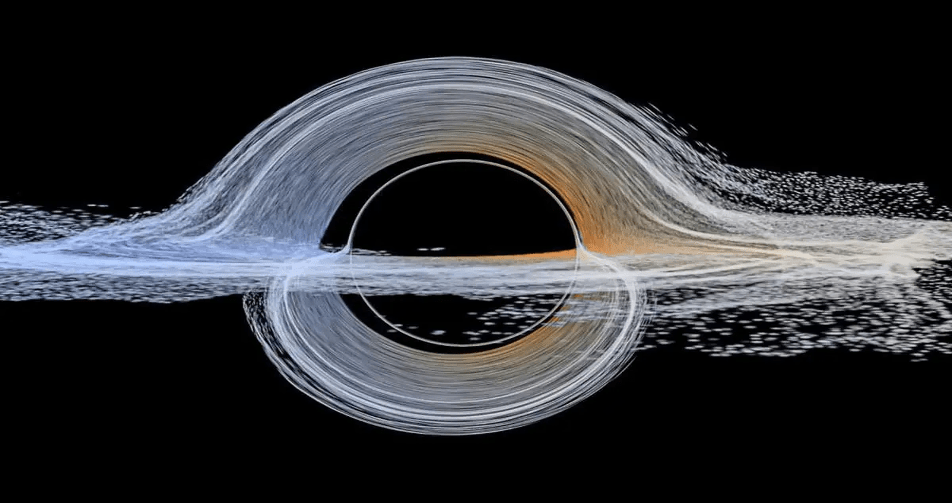
Kip Thorne’s 2015 illustration of the effects of quantum gravity.
Catalog Description
[CAPS] [M] Advanced Topics in Literature 3 May be repeated for credit; cumulative maximum 6 hours. Course Prerequisite: Certified major in English; junior standing. Seminar with term paper project; focused studies in American, British, or global literatures.
Course Description
Lewis Mumford argues in Technics and Civilization that “[t]he clock, not the steam engine, is the key machine of the modern industrial age.” From deep time to time synchronization, computer timing to urban acceleration and general and special relativity, modern life is characterized by a multiplication and layering of temporal infrastructures that increasingly govern our lives. Temporal infrastructures work in tandem with the coding of bodies to unevenly repeat the rhythms of cultural hierarchy: black bodies can be coded as slow or ‘out of sync’ with modernity, while differently-abled bodied can be subjected to futurist fantasies of technological solutionism. This course explores how media and fiction work dialectically to produce different speeds, rhythms, frequencies, and scales of temporality. For instance, HG Wells’s The Time Machine is seen as the first machining representation of time travel, but this novelty is juxtaposed by Wells’s anxieties about the finitude of white supremacy when compared with the endless expanses of evolutionary biology. Requirements include two presentations, weekly Reading Notes, and a final multimodal project.
Schedule
Assignments Are Due On Date Listed. Schedule May Change with Notice from Me. Some of the links connect to WSU’s canvas site and are not accessible to people who have not enrolled in the class and are not signed into canvas.
| Class | In-Class Learning Experiences | Texts Due | Assignments Due |
| T: 8/22 | Quotes about science fiction and time travel from: Darko Suvin, Frederic Jameson, Samuel Delany Watch: “The History of Time Travel” | ||
| Th: 8/24 | Think, Pair, Share: Consider these different times in the context of Mumford’s argument about mechanism and the clock. | Lewis Mumford, “The Monastery and the Clock.” From Technics and Civilization Look up the following from the Dictionary of Philosophical Untranslatables : Entstellung, Eternity/Duration/Aion/Chronos, Jetztzeit, Memory, Moment, Present, Stimmung, Time. (Warning: Large pdf file). | Reading Notes from me. |
| T: 8/29 | NO CLASS | ||
| Th: 8/31 | Think, Pair, Share:Why does Wells call his books “scientific romances?” Think about the romance as a genre and its connection to science fiction and time travel. | HG Wells, The Time Machine | Reading Notes 1: By midnight Wednesday post four questions, four quotes, and four takeaways from the reading for discussion. |
| T: 9/5 | Think, Pair, Share: How does HG Wells adopt or appropriate Darwin’s work? How does he address the problem of narrative in terms of evolution that Beer lays out? | Wells appendix B and D in the Broadview Edition (“The Evolutionary Context: Society”; “The Spatiotemporal Context: The Fourth Dimension” Gillian Beer, “Introduction,” Darwin’s Plots. | |
| Th: 9/7 | Watch: “What is hauntology?” Think, Pair, Share: Is this novel science fiction? A time-travel story? history? | Octavia Butler, Kindred (9-108) | Reading Notes 2 |
| T: 9/12 | Analysis: Find examples in Butler’s text where we get hints of what Sharpe calls “the wake.” | Octavia Butler, Kindred (109-188) Hafizah Geter, “Everything Comes Back to Christina Sharpe’s In the Wake.” | |
| Th: 9/14 | Watch: Kindred, “Dana” Adaptation: How do the beginnings of the novel and the show differ? Does this show enhance the novel or are there places where it falls short of the novel’s vision? | Octavia Butler, Kindred (189-end) | |
| T: 9/19 | Watch: Primer (2012), dir. Shane Carruth | Reading Notes 3 | |
| Th: 9/26 | Finish: Primer (2012), dir. Shane Carruth Think, Pair, Share: What different takes on the Butterfly Effect do we get from Carruth and Bradbury? What’s the connection between time travel and the short story? film? | Ray Bradbury, “A Sound of Thunder.” | Reading Notes 4 |
| Th: 9/28 | Think, Pair, Share:What is the relationship between time and communication? What are we to make of Einstein’s interest in communication technologies? | Jimena Canales, “The Media of Relativity.” Ursula K. LeGuin, “Semley’s Necklace.” Ursula K. LeGuin, “Solitude.” | Reading Notes 5 |
| 10/3-5 | NO CLASS | ||
| T:10/10 | Watch: Cloud Atlas, dir. The Wachowskis Research: In groups of 4, look up and give short presentations on the following: Slavery in New Zealand Aleksandr Solzhenitsyn Controversies surrounding the film David Mitchell’s other books Anthropocene as represented in the film. | Reading Notes 6 | |
| Th:10/12 | Finish: Cloud Atlas, dir. The Wachowskis Response:What does Cloud Atlas contribute to history and historicism? | Heather Hicks, “’This Time Round’: David Mitchell’s Cloud Atlas and the problem of Historicism.” (Read Online via WSU Library). | |
| T: 10/17 | Think, Pair, Share: How would you compare the intertwined historical periods in Mandel’s novel with Cloud Atlas? | Emily St. John Mandel, Sea of Tranquility (1-168) | Reading Notes 7 |
| Th: 10/19 | Watch: Station Eleven, “Wheel of Fire” Response: Both stories represent pandemic-driven apocalypses. Which do you feel is “more realistic” and why? | Emily St. John Mandel, Sea of Tranquility (169-end) | Reading Notes 8 |
| T: 10/24 | Watch: Dr. Who, “Blink” Response: How would you characterize the terror represented by the Weeping Angels? How does it speak to our own fears and fantasies about time? | ||
| Th: 10/26 | NO CLASS | ||
| T: 10/31 | Think, Pair, Share: How is the time travel in this novel impacted by its epistolary form? | Amal El-Mohtar and Max Gladstone, This is How You Lose the Time War | Reading Notes 9 |
| Th: 11/2 | Watch: In Time, dir. Andrew Niccol | Reading Notes 10 | |
| T: 11/7 | Watch, In Time, dir. Andrew Niccol Think, Pair, Share: Philosopher Martin Hagglund has argued that the only real freedom we have as human beings is to decide what to do with our limited lifetime. How does In Time literalize some of the ways we use capitalism to give the rich more time at the expense of the poor? | James Woods, “If God is Dead, Your Time is Everything.” The New Yorker | Reading Notes 11 |
| Th: 11/9 | Watch: Mark Fisher, “No Time” Jonathan Crary, “Chapter 1,” 24/7 | ||
| T: 11/14 | Respond: How many times did you “read” Meanwhile? What does it mean to read this text? | Jason Shiga, Meanwhile | Reading Notes 12 |
| Th: 11/16 | Play: Twelve Minutes Think, Pair, Share: Consider the difference between playing a game and time and time in narrative. How does this game and Jason Shiga’s graphic novel exemplify such differences? | Reading Notes 13 | |
| 11/20-24 | NO CLASS | ||
| T: 11/28 | Watch: Arrival Respond: What is “The Greatest Weight” in Chiang’s story? What’s the test? | Nietzsche’s Idea of Eternal Recurrence Ted Chiang, “Story of Your Life” | Reading Notes 14 |
| Th: 11/30 | Watch: Arrival Think, Pair, Share:We’ve read several works this semester that connect time travel to machines and communication. How does the circular temporality of Arrival complicate how other stories viewed this connection? | ||
| W: 12/4 | Final Class: Discuss Final Projects |
Bibliography
Readings/Films/Course Ideas:Mariam Ghani. Interdisciplinary Seminar: Time. Spring 2020. Bennington College.
Jay Clayton. Science/Fiction in Nineteenth-Century Literature. Fall 2019. Vanderbilt U.
Suggested in conversation: Lorie Emerson, Anya Guy, Christian Haines, Monique Morgan, Alissa Bourbonnais, Devin Griffiths, Steven Shaviro, Cassandra Wild, Mark Sample.
Policies and Design:
John Aycock and Jim Uhl. “Choice in the Classroom.” ACM SIGCSE Bulletin. 37.4 (2005): 84- 88.
Ashley Boyd. Young Adult Literature. Fall 2015: Washington State U.
Phil Wegner. A Return to the Scene of the Postmodern. Spring 2020. U of Florida.
Anne-Marie Womack, Annelise Blanchard, Cassie Wang, Mary Catherine Jessee. Accessible Syllabus. Web. 3 August 2016.
Anne-Marie Womack. First-Year Writing: Rhetoric and Research in the Digital Era. Spring 2014: Tulane U.


