In his history of the time-travel genre as a “narratological laboratory,” David Wittenberg curiously argues that H.G. Wells’s The Time Machine articulates time by referencing the cinema: “the mere press of a lever accomplishes the task of advancing, reversing, or modulating temporal movement, as it would, for instance, in a kinetoscope, a protocinematic device with which Wells was very familiar” (86). The parallel between media and time machine is invoked in the field of media archaeology; in particular, Wolfgang Ernst description of time as “a complex layering of presence and past(s), rich forms of temporal articulation [that] can be identified in a chrono-tonal sense,” as a useful alternative to question of whether time is subjective or objective. This presentation will show how Wells’s book develops a machinic form of time travel as a literary device to delineate and juxtapose three different scales of temporality developed in the nineteenth century: the rapid temporality of the film projector, the prescise of the industrial clock, and the longue durée of natural selection. While Wittenberg sees the time-travel genre as hinging on the development of the time paradox, I suggest that the development of time-critical processes in the nineteenth century reveals Wells’s developing sense of temporal mediation as a fundamental topic for science fiction.
For Ernst time-criticality is the delineation and processing of time by media operations. One of his best examples is mechanical escapement in pendulum clocks. While the sundial measures time by the shadow cast from the sun, forming an indexical relation between time and the sun, mechanical escapement processes time as a series of standardized units operating through a mechanical oscillation that does not have an indexical reference other than its own measurement. I suggest that Wells’s book develops time travel as a mechanism to throw into relief the difference between the cultural artifact as enveloped in a history and the operative mechanism processing time. While this dramatization is particularly present in the artifacts the traveler uses to prove that he traveled to the future, a not-so-subtle reference to the surplus value extracted from colonial holdings, it can also be seen in the mechanism itself as engaging in the act of disciplining organisms from vastly different moments in history through a radical form of time synchronization. For me, Wittenberg’s focus on narratology should be supplemented with an account of how media construct various experimental possibilities for narrative. The machinic modulations of time in Wells’s novel provides a powerful example of the entangled relationship between time, media, and narrative. While the extraction, synchronization, and modulation of time alongside their relationship to capitalist extraction will form the central focus of the presentation; it will also show how Wells’s novel anticipates more recent time travel books that are also interested in time-critical mediation, such as William Gibson’s The Peripheral.
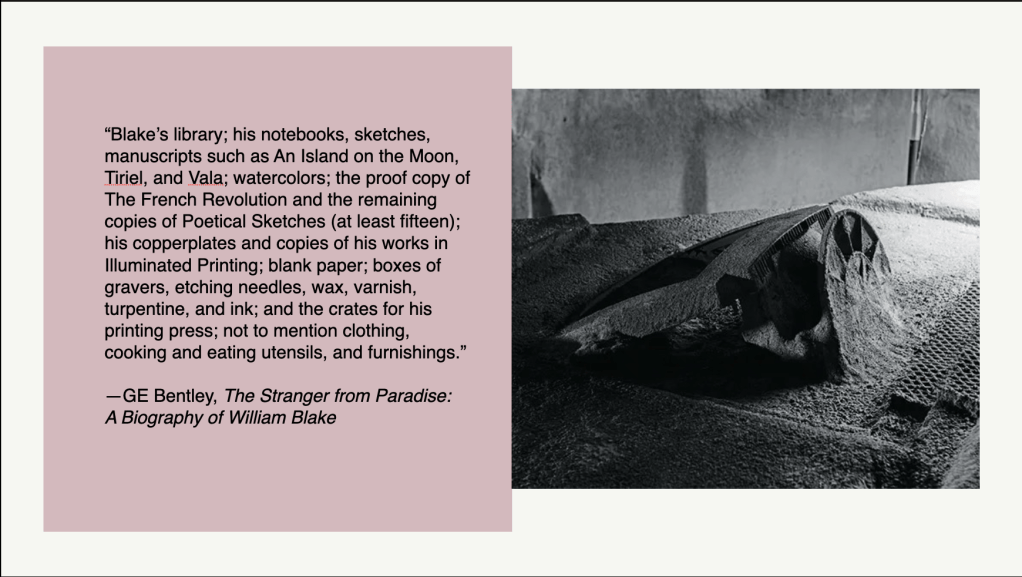
During their move to Felpham in 1800, the Blakes noted that among their luggage were “Sixteen heavy boxes & portfolios full of prints.” Biographer G.E. Bentley provides an expanded inventory of the “worldly goods” they brought with them:
Blake’s library; his notebooks, sketches, manuscripts such as An Island on the Moon, Tiriel, and Vala; watercolors; the proof copy of The French Revolution and the remaining copies of Poetical Sketches (at least fifteen); his copperplates and copies of his works in Illuminated Printing; blank paper; boxes of gravers, etching needles, wax, varnish, turpentine, and ink; and the crates for his printing press; not to mention clothing, cooking and eating utensils, and furnishings.
So many prints and plates loaded onto a cart, traveling through the country landscape, make for a strange and precarious temporal assemblage. The cart trailing the Blakes housed the completed manuscript portions of Vala, or the Four Zoas, one of Blake’s major works, along with sections that would later be reworked for Milton and Jerusalem. Work published prior to his move was also on the cart: fifteen copies of Poetical Sketches (which only had a print run of 50 copies), at least a single copy of all of the illuminated books produced up to that point in his life (some 14 different works including – among others – the Continental Prophecies, the Songs, and the Urizen books), and the instruments that he would later use to create prints, watercolors, and illustrations: chemicals, mechanisms, metal. We can also imagine the more banal items that supported Blake’s work — the food and furnishing which sustained his life — as mixed in, tied to, or shoved between the more recognizable artifacts of this strange archive in motion. What arrived to the Blakes’ residence on South Moulton Street on the cusp of 1804 must have been reminiscent of a media archaeological excavation site, with multiple scales ¬of temporality sedimented together and traveling through space and time.
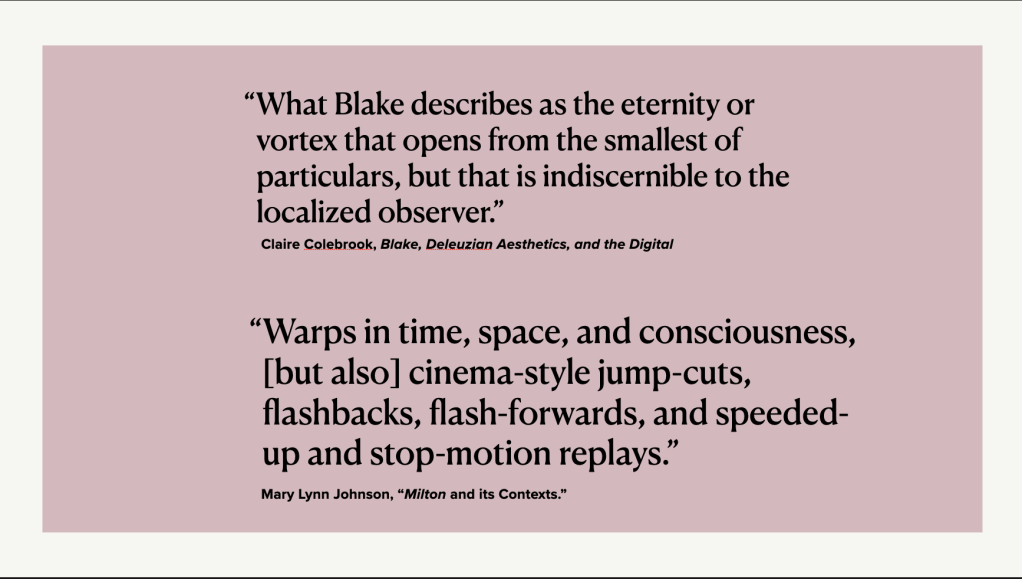
[Slide 3] 1804 saw what many scholars believe to be the beginning of Blake’s composition process for Milton: A Poem. A central part of transformation in Milton is a renovation of time itself. As Claire Colebrook puts it, the poem Milton distinguishes between historical time and “what Blake describes as the eternity or vortex that opens from the smallest of particulars, but that is indiscernible to the localized observer.”For Mary Lynn Johnson, these vortices are best described as “warps in time, space, and consciousness” but she also compares them to “cinema-style jump-cuts, flashbacks, flash-forwards, and speeded-up and stop-motion replays,” suggesting that Blake’s work may have more in common with cinema than most Romantic poems. In fact Johnson’s cinematic language resonates with the interdisciplinary field of media archaeology in which the manipulation of temporality performed by cinematic montage is abstracted into a research method that can be applied to any medium. The field has its disciplinary roots not only in the computational histories of Friedrich Kittler, Wolfgang Ernst, and Jussi Parikka but also in scholarship describing the temporal complexities of the cinematic apparatus and especially the cinematic archaeology of C. W. Cerem, the movement and time images described by Gilles Deleuze, and the alternate histories of the cinema proposed by Thomas Elsaesser. Media archaeology is particularly important in understanding how Blake’s works in illuminated printing process time to generate particular depictions of time in Milton but also as Blake’s work shifts to new temporalities and materialities in various printed and digital editions.
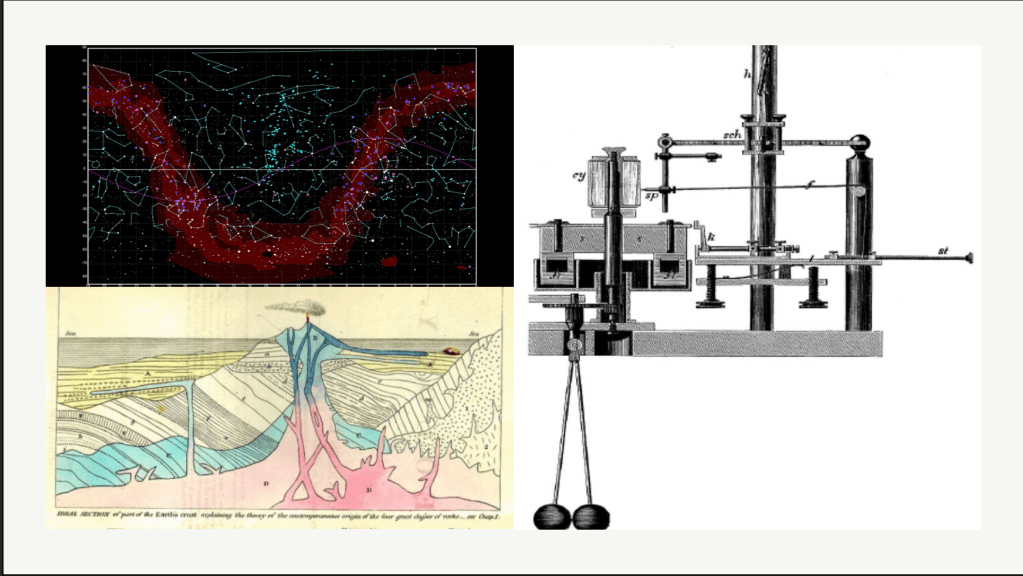
[Slide 4] Further, the experimental and theoretical underpinnings of media archaeology were developed under the sign of Romantic science, including James Hutton’s and Charles Lyell’s respective theories about deep time, William Herschel’s deep sky surveys, and Hermann von Helmholtz’s work on the temporal and physiological thresholds of sense perception. John Durham Peters argues that Romantic science and Romantic media were tightly intertwined, particularly since Herschel was intimately aware of the “signal and channel properties of the telescope.” As a concept emerging in dialogue with Romantic science, the vortex in Blake’s poem Milton exemplifies the emergent transformations of time occurring during his life, while Milton as an illuminated book also operationalizes temporal infrastructures in its production and reception. This talk attends to what Saree Makdisi calls the “gap between historical experience and history itself,” and elaborates in terms of the latter as “the rules and regulations – the laws – according to which historical experience is recorded and narrated” by demonstrating Blake’s own awareness of not only textual mediations of time but also how such mediations are constructed by cultural techniques of counting and the implementation of technological media that archive, play back, and engage in time-axis manipulation. First, I’ll look at Blake’s theory of the vortex in one of the more celebrated passages from Milton as a response to the emergence of time-critical media in the early Romantic period. Finally, I’ll offer some reflections on the poem’s digital materiality and recursive history by looking at their metadata, policies, and logistics in The William Blake Archive.
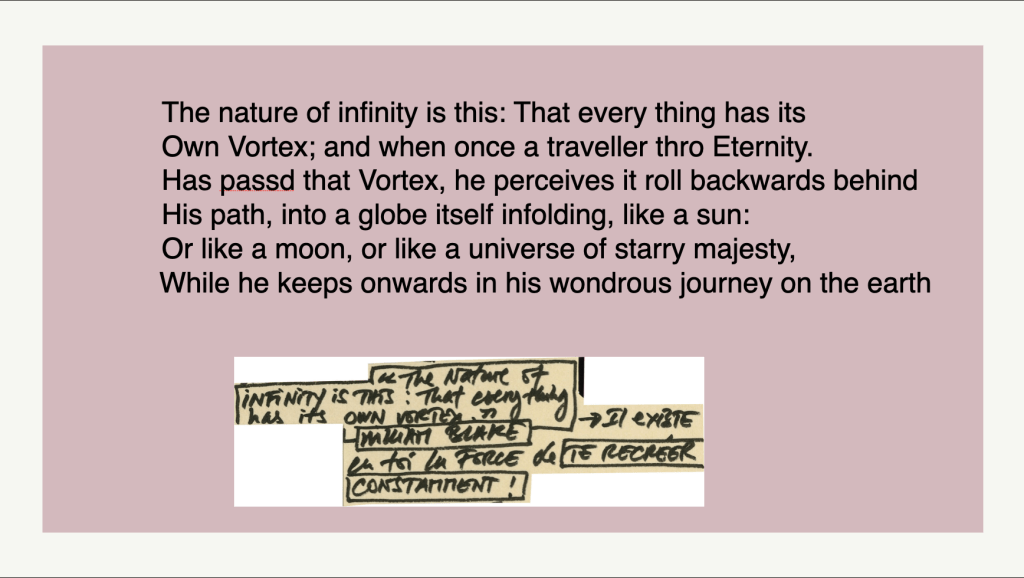
[Slide 5] One of the most celebrated passages in Milton describes Blake’s vortex, in which travelers pass from a finite space to a plane that opens itself onto Eternity:
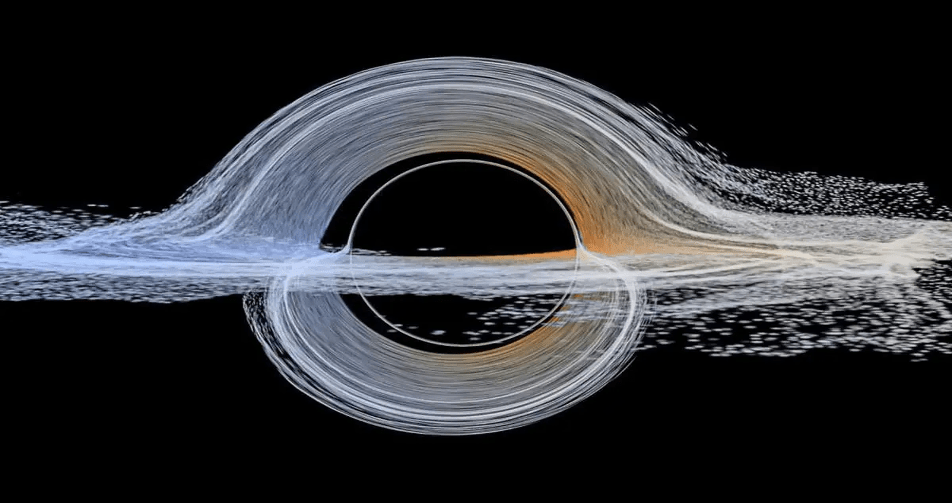
The nature of infinity is this: That every thing has its Own Vortex; and when once a traveller thro Eternity. Has passd that Vortex, he perceives it roll backwards behind His path, into a globe itself infolding, like a sun: Or like a moon, or like a universe of starry majesty While he keeps onwards in his wondrous journey on the earth
Blake also describes the Earth as “one infinite plane,” suggesting that this plane is infolded as the traveler moves through it. As several authors have shown, Blake’s vortex references Rene Descartes’s vortex theory of gravitation, which holds that planets, comets, and other stellar phenomena travel along bands of particles as they move across the solar system. Instead of existing in a void, as in Isaac Newton’s theory of gravitation, Descartes’s theory of gravity describes space as a plenum with vortices attracting celestial bodies much like physical objects circle around funnels. These bodies rest upon the vortex; consequently, the shape of the vortex provides each celestial body with its particular orbit. Emily Thomas calls Descartes’s vortices “akin to whirlpools or whirlwinds,” and argues that Descartes’s vortex theory is important because “it is the first early modern mechanist account aiming to explain the current state of the universe purely via matter” (47). As a material mechanism, Descartes’s vortex provides a powerful explanation for the movement of celestial bodies without referencing metaphysics.
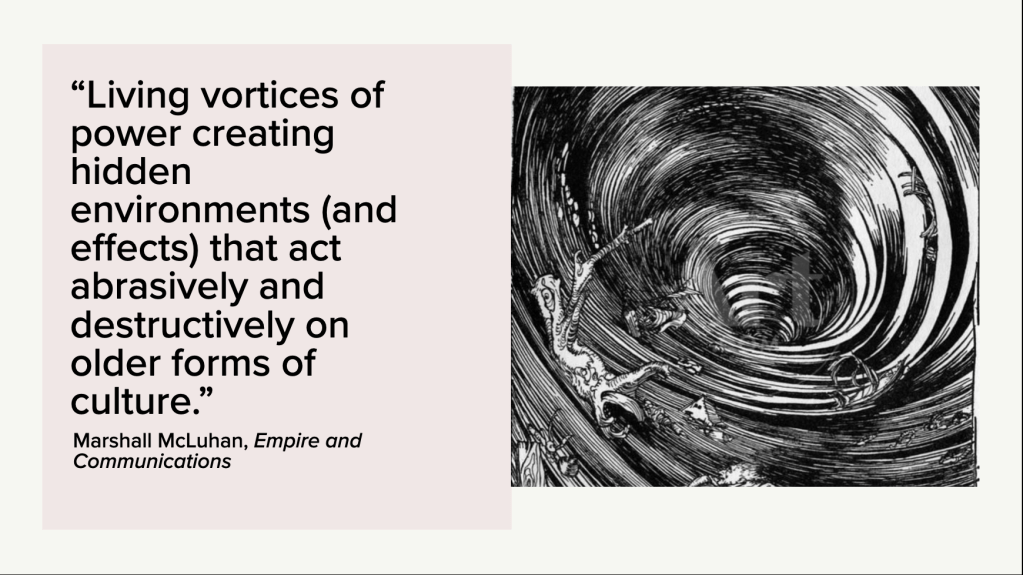
[Slide 6] Blake transforms Descartes’s mechanist account of the vortex into a media theory illustrating the dynamic interactions between philosophical systems, space, and time. This transformation challenges the industrial temporality of the early nineteenth century even as it also anticipates the recursive temporal structures of post-industrial capitalism. Accordingly, I look to the vortex in Blake’s Milton to underline the challenge such structures make to linear temporalities and to suggest that media archaeology’s readings of time were anticipated by Blake’s illuminated poetry. Blakean vortices are not planetary funnels but, rather, phenomenological ruptures in the fabric of space and time that transform them into heterogeneous, contiguous, and recursive structures. In the process, the vortex reveals the mediated experience of temporality, putting into relief the interconnections between perspective, subjectivity, and time. Blake sees media operating in a way similar to Marshall McLuhan’s description of them as “living vortices of power creating hidden environments (and effects) that act abrasively and destructively on older forms of culture.” McLuhan develops his idea through a reading of Edgar Allan Poe’s “A Descent into the Maelstrom,” in which a ship is caught in a hurricane-like vortex that accelerates the time and aging of the unlucky people on board. Yet as scholars like Andrew Burkett have pointed out, McLuhan’s work on media is also heavily indebted to Blake’s belief that his works can radically transform the experiences of people reading them. In this sense, Eternity, for Blake, is not a limitless space but a separate medium opened up by the vortex that interrupts homogeneous time. In the language of media archaeology, vortices act as operational shortcuts between linear moments of history.
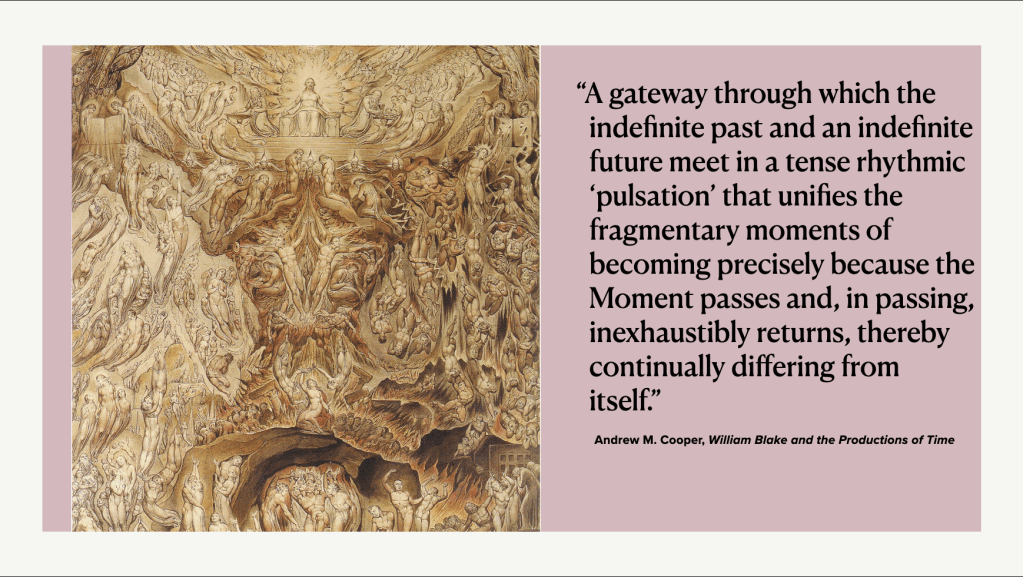
[Slide 7] Recursions in this passage reveals the coexistence of Eternity with the productions of time, suggesting a turn to time-critical analysis when devising an intervention into the temporal politics of the early nineteenth century. Explaining this coexistence, Andrew M. Cooper defines the Blakean moment as “a gateway through which the indefinite past and an indefinite future meet in a tense rhythmic ‘pulsation’ that unifies the fragmentary moments of becoming precisely because the Moment passes and, in passing, inexhaustively returns, thereby continually differentiating from itself.” Like Nietzsche’s Eternal Return of the Same and Gilles Deleuze description of differentiation from Difference and Repetition, the Blakean moment conceptualizes difference as that which produces individuality, similarity, and the Same. But even more importantly, the contradicting currents of the Blakean vortex resonate with controversies regarding the nature of time in Romantic science as well as the signal and channel properties of Romantic media – anticipating what we might call the recursive loops of cybernetics and post-industrial capitalism.
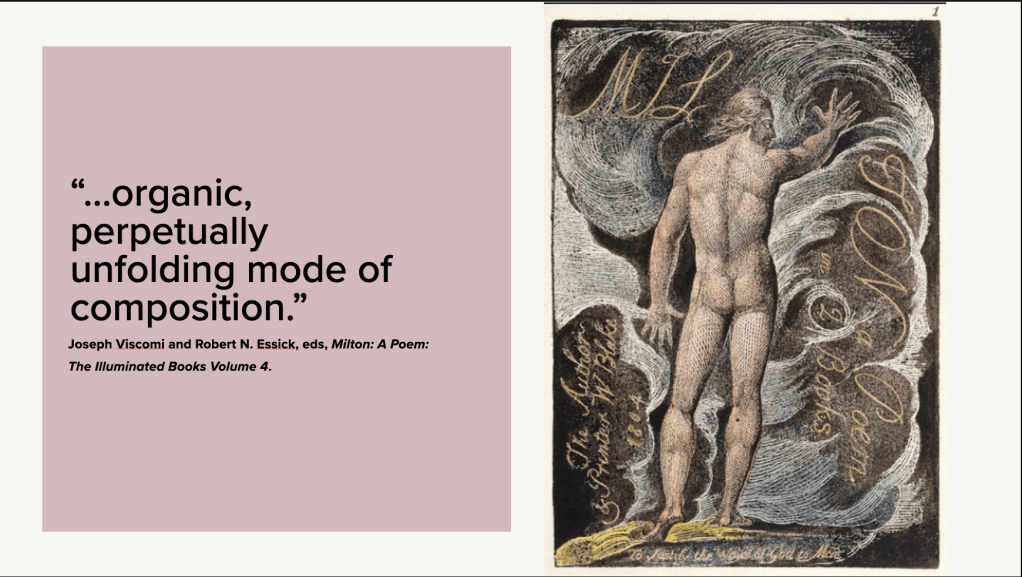
[Slide 8] These recursions happen not only in the poetic themes of Milton, but also in the controversies surrounding the date of its publication and digitization in The William Blake Archive. First, the metadata of the frontispiece of Copy C mention that “some of the poem might have been written before Blake left Felpham in the fall of 1803” and “[s]ome of the coloring may have been added as late as c. 1820,” hinting at the complicated publication history of the poem. In fact the many problems surrounding the dating of Copy C illustrate the complicated temporal assemblage at the heart of Milton’s media materiality: that both Milton and Jerusalem were initially composed as part of Vala, or the Four Zoas; that eventually the structural limitations of Vala could no longer hold the many ideas that kept being generated while Blake composed the poem; and that he split of the other two poems from Vala as a result. Recounting these complications, Joseph Viscomi calls the process of writing Milton as an “organic, perpetually unfolding mode of composition.” Clearly, some of the ideas for Milton are older than the mostly convenient 1804 date printed on the frontispiece.
[Slide 9] Complicating this already elaborate set of questions surrounding the dating of Blake’s Milton is its digitization on the Archive. The media materiality of the Archive has been a topic of concern since at least N. Katherine Hayles’s 2003 article “Translating Media: Why We Should Rethink Textuality,” in which she argues that digitized versions of Blake’s poems are “simulating, not reproducing” them. And yet few scholars have applied these concerns about materiality to the time-critical effects of media and their impact on the historicizing of Blake’s work. These temporal questions are especially important when, as Jussi Parikka puts it, “our regimes of memory are embedded in dynamic, changing and processual software platforms.” Processual software programs transform the cultural techniques governing historical narrative, while shifting the questions we should ask regarding historical readings of Blake. For instance, Ernst and other media archaeologists don’t see recursion as just the repetition of a phenomenal experience or a date. Instead, recursion describes the method by which time-critical algorithms enact, for instance, operative functions to produce digital images, transmit communication over internet relays, or download data from a server.
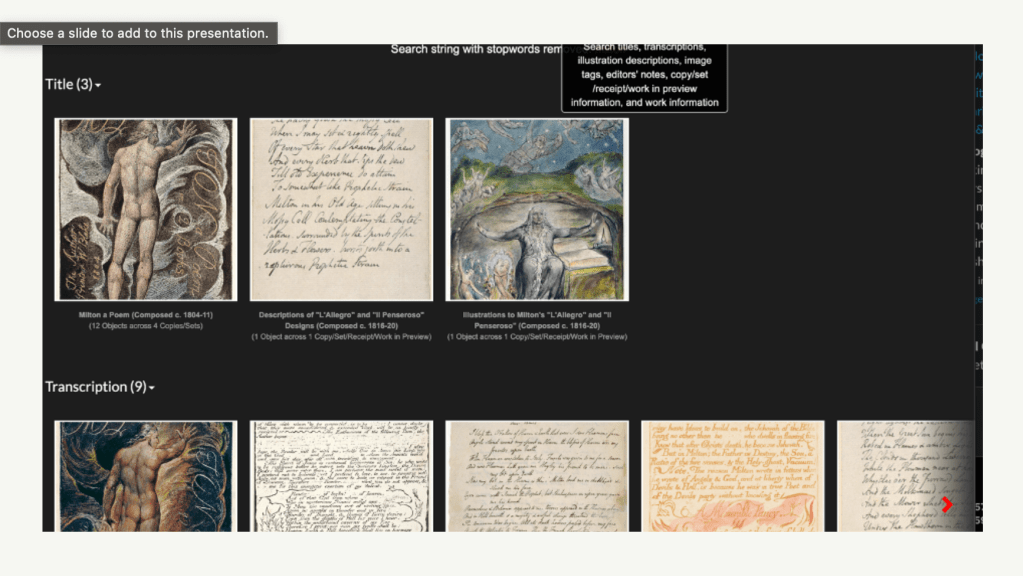
[Slide 10] To give but one example, metadata markup can look like literary interpretation to human users, but it also participates in time-critical effects beyond human intention or interpretation. Since digital memory is not just storage, it must be actively constructed by the processing of the search engine when a user looks for a particular theme or idea within Blake’s work. The Archive maintains its own search engine on its site, which as of 2023 is indexed by Solr. Solr is an open-source program that is used on several commercial and public sites, like the Internet Archive, Instagram, and DuckDuckGo. This program selects a set of searchable words that show up not only in their own search engine but also on sites such as Google. However, the search engine on the Archive is more specialized due to the metadata categories ascribed by Solr. According to the Archive’s Technical Summary, their Solr instance “has three types of documents: a blake_work, a blake_copy, and a blake_object document. This structure allows searching within a work within a copy within an object. […] A user may select a resulting object from a particular copy of a single work, and may filter a search by date, type, or medium.” By indexing in this way, human-generated metadata replicates affordances of print-based textual scholarship, enabling someone with knowledge of print-affordances to access relevant content. Access, in this sense, acts as an operative temporality. On top of poetic questions in Milton regarding the identity of the character in Blake’s poem and philosophical questions about the relationship between the materialities of various copies and our understanding of Blake’s text—queries inherently invoked by the interpretive complexities regarding metadata prescribed for the poem—temporal and historical questions also arise when a user types in “Milton” and is presented with a series of images displayed by the Archive.
In the search shown on the screenshot, there are three results in “Title” and nine results in “Transcription.” Scrolling down includes the following categories with the number of results in parentheses: Illustration Description (5), Image Tag (3), Editor’s Note (5), Copy/Set/Receipt/Work-In-Preview Information (3), and Work Information (10). Already in the display of these texts, we are given an operative assemblage unavailable with any other search. And yet, beyond the desire of the user to find a particular object, such assemblages are not considered narratively meaningful. The search function on the Archive reinscribes the gap between cultural history (in the sense that the user enters “Milton” to find Blake’s illustrations to John Milton’s work or Blake’s poem Milton) and time-critical operations (in which the display of these objects constructs operative shortcuts between texts otherwise dispersed in historical time). It also reveals the recursive and processual nature of the software platforms shaping the digital archiving of Blake’s work.
Further, while metadata categories on the Archive replicate print affordances, Ernst points out that many scholars confuse media affordances for interpretive choices and ignore how much these affordances already inscribe our posthuman subjectivity as a construction of media. He says that human-generated metadata is “logocentric,” since otherwise arbitrary tags are associated with one another through human intervention but are then made to seem historical and meaningful. In the process, “the technical machine becomes perfectly humanized on the figurative, phenomenal level.” Yet, this perfect realization only demonstrates the posthuman condition. In a non-anthropocentric view, he continues, “if a machine can perfectly emulate human memory dynamics, the human memory system might be a technological mechanism itself.” The Archive’s use of Solr relies upon human-generated metadata that replicates print standards, but these standards don’t just ensure the production of an archive with a certain level of quality. The print-inspired categories of the Archive’s metadata also reproduce a version of what Kittler calls a discourse network or inscription system in which the human subject is constructed out of the reproduction of technical standards; or, in his words, a “network of technologies and institutions […] allow a given culture to select, store, and process relevant data.” It’s unclear if Blake or Milton are more relevant to our current discourse network than they were in 1804. But Blake, Milton, and 1804—at least in Ernst’s posthuman formulation of digital memory—exist primarily for the recursive storage and processing of data.
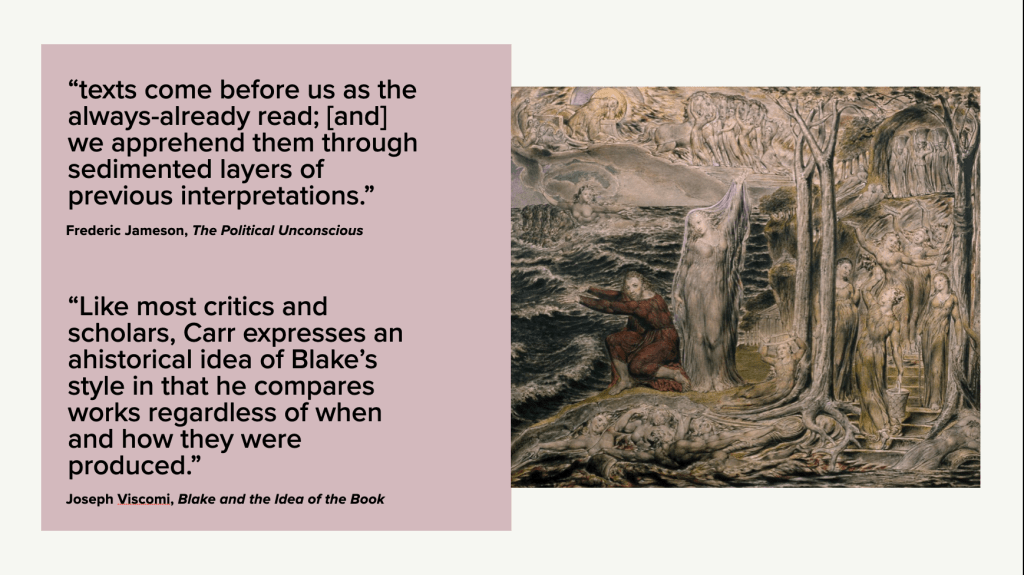
[Slide 11] These time-critical techniques of digital archives also resurrect debates surrounding the reading of Blake’s work and do so in ways that may not have been intended by their authors. In Blake and the Idea of the Book, Viscomi famously critiques Stephen Leo Carr’s argument that print differences in the copies of Blake’s poems signal a radical challenge to the print industry of his day. “Like most critics and scholars,” Viscomi explains, “Carr expresses an ahistorical idea of Blake’s style in that he compares works regardless of when and how they were produced” (165). The Solr indexing system used by the Archive does not erase Viscomi’s crucial historical point or the nature of the challenge Blake intended, but it does throw into question how we understand the cultural techniques that are constructing history. Frederic Jameson shows that “texts come before us as the always-already read; [and] we apprehend them through sedimented layers of previous interpretations.” Additionally, texts are processed through various techniques and technologies with their own affordances—material and temporal. These create effects that complicate a normative historicist reading, including time-critical shortcuts and recursive loops. Looking at the search results on the Archive reveals not a historicized archival display but a mode of reading appropriate to the time-critical techniques of the digital archive itself. While Essick, Viscomi, and Eaves have always admitted the medial properties of the Archive, Rachel Lee states that their goal “is to represent and clarify Blake’s original manuscript with minimal editorial presence.” Even so, the fact that these image-focused search result displays remain on the Archive, along with the capability to view all copies of a particular illuminated book alongside one another, reveals that the debate between Viscomi and Carr is not one of historicity versus ahistoricity. Rather, we see a struggle between two technical standards: one that holds tightly to a single editorial endpoint for Blake scholarship as the meaning of history and another that traces the potential forms that Blake can take as a multiverse of modal possibilities.
[Slide 1] Much of this talk is a preliminary reflection on a project I’m currently in the process of conceptualizing. I caused a bit of a stir in 2013 at the National Association for the Study of Romanticism (NASSR) when I admitted that I had never gazed upon one of Blake’s original works. It felt like a scandal. I signed up for the “Blake printing workshop” put on for NASSR 2023 by William Brewer, Alexander Reiger, and Thora Brylowe at Rice University’s Fondren Library in order to gain a more tactile appreciation of Blake’s work. In addition to recounting my experiences there, I’d like to briefly discuss a broader project I’m in the preliminary stages of planning regarding Blake’s plates and digital reproduction.
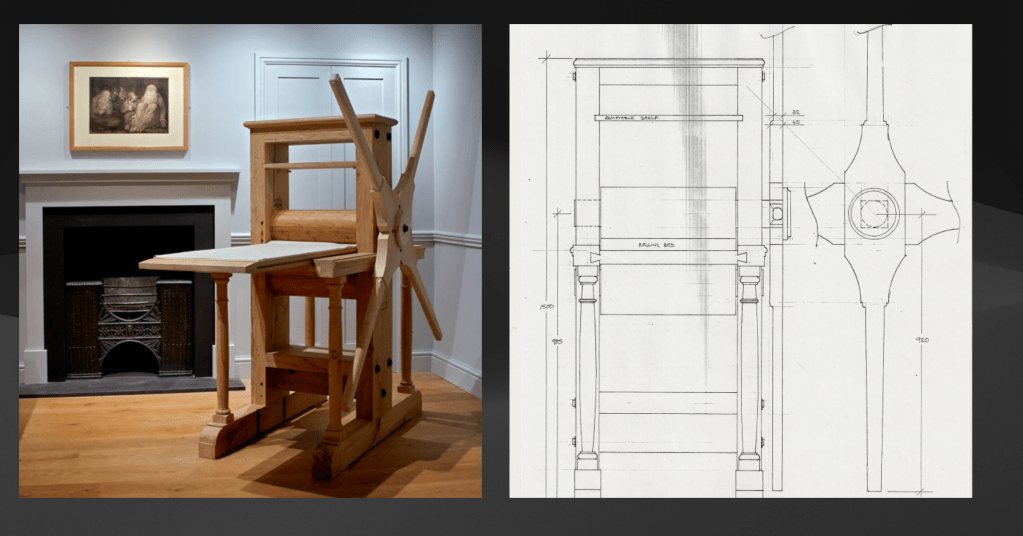
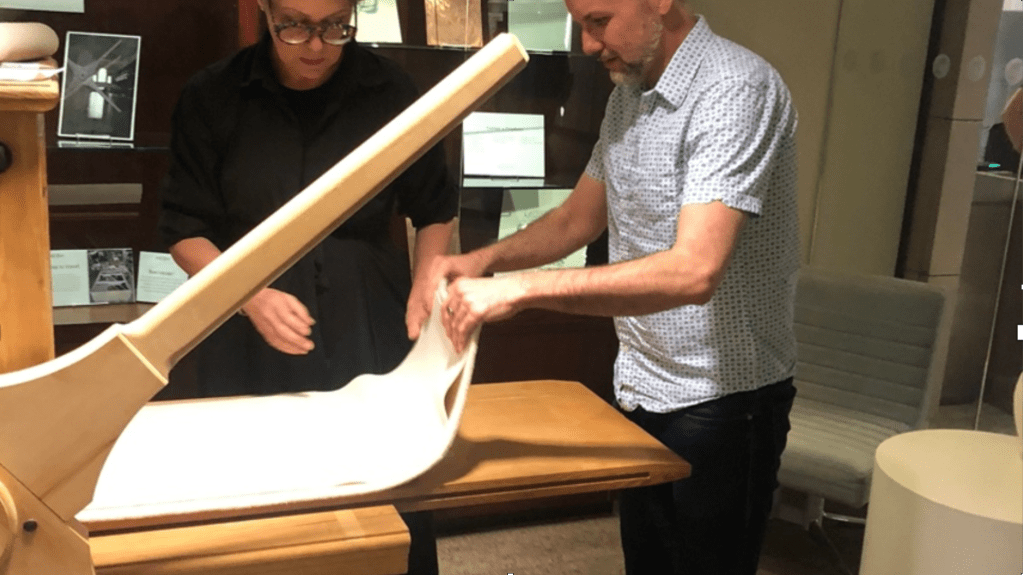
[Slide 2] The “Blake printing workshop” featured Michael Phillips’s replica of Blake’s eighteenth-century printing press and his remakes of Blake’s copper plates. The star-wheel press had been housed at Oxford University for years, until it was acquired by Rice University in March 2023 — only a few weeks before I saw it. Philips collaborated with Bates and Lambourne furniture makers (BLAM) to create a replica of Blake’s star-wheel press. The furniture makers were originally presented with reclaimed materials, including the former bell frame of St. Mary’s Church, High Wycombe. They recount the many problems that can emerge with reclaimed materials: “[E]ven new planks can hide all manner of metal shrapnel, occasionally literally, but also the odd staple that held the barbed wire that the tree grew round, and not unusually the shotgun pellets that missed the pheasant. Trees have a way of consuming history; our timber merchant claims they once had a trunk that contained an entire bicycle within its knotty entrails.”
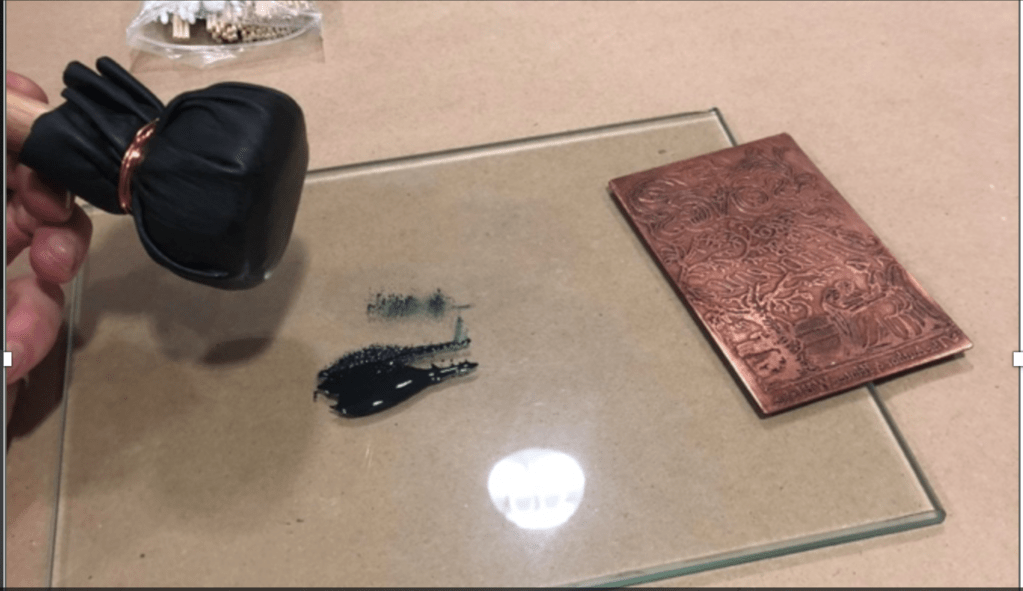
[Slide 3] I spent about three hours with the replica, much of it mixing ink, applying the ink to plates using a ‘dauber,’ then printing the plates onto paper with Philips’s press. Of course, we did not have time to etch or engrave the plates themselves, since that would have taken much longer. Joseph Viscomi mentions that the “ink” applied to the plates was likely made out of resin and turpentine mixed with linseed oil, what many etchers call “stop out varnish,” which is “used to paint over lines and areas to ‘stop’ them from being bitten deeper by the acid. By biting a design multiple times and stopping out different lines and areas each time, the etcher varies the depths of the intaglio lines and thus their tonality, creating the illusion of aerial perspective and modeling.”
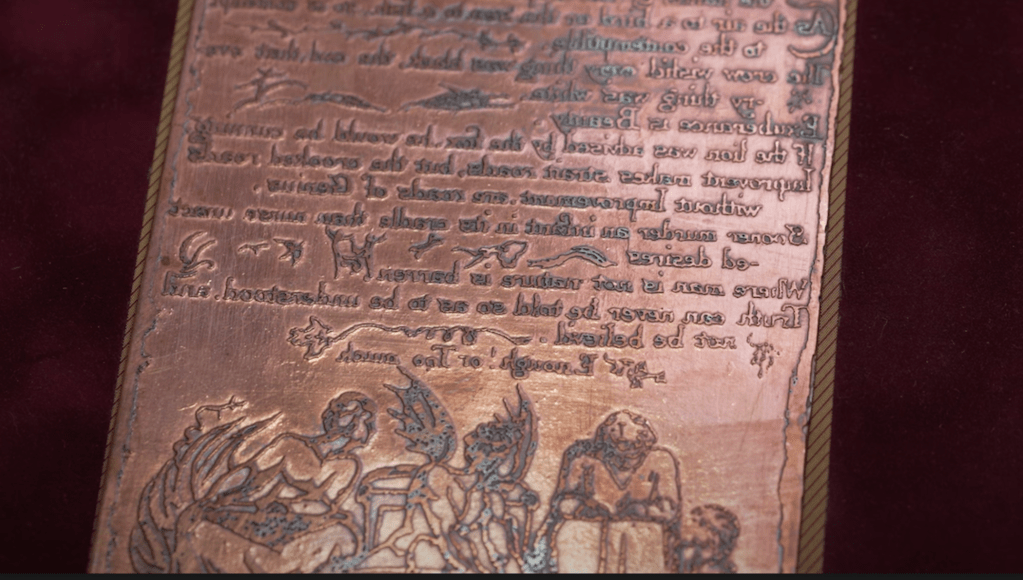
[Slide 4] I quickly noticed the incredibly small size of the words etched into the copper plates. Take a look at a quick close-up of a plate from The Marriage of Heaven and Hell to get a sense of the size .Philips reports that Blake’s method of etching creates reliefs that are almost microscopic in the depth that is created by the application of nitric acid: “[A plate from America: A Prophecy, for instance] was etched in two stages to prevent underbiting, first to 0.05 mm. followed by a further 0.07 mm., the total depth of bite amounting to no more than 0.12 mm.” The delicate bite relief created through this method has implications for attempts to reproduce Blake’s prints in 3d printing, which we’ll return to later on.
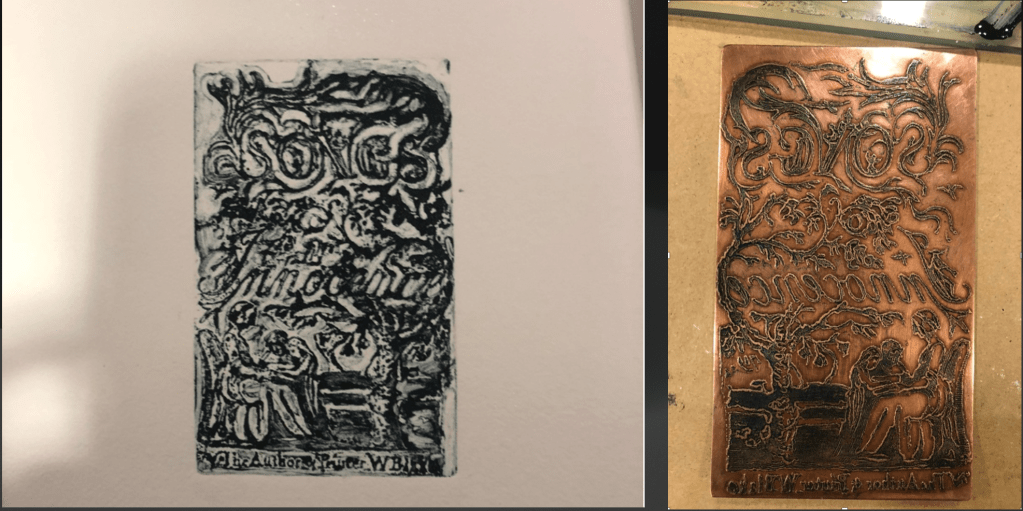
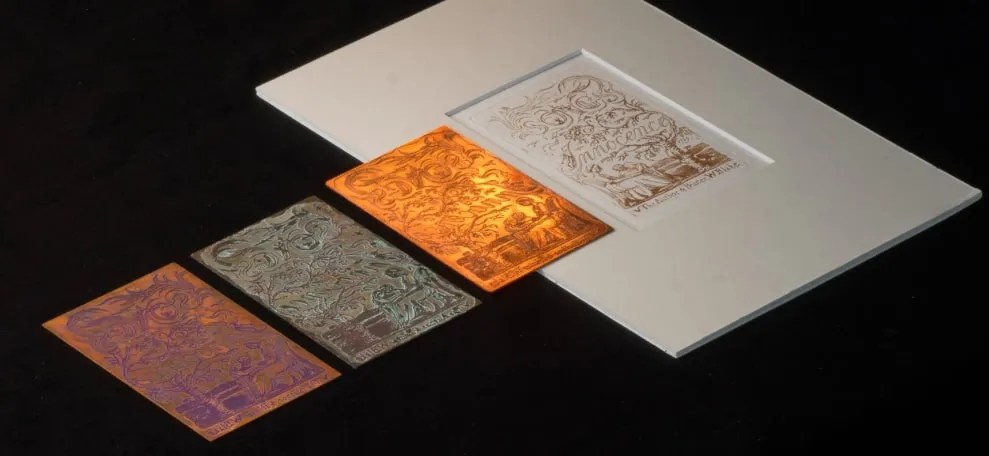
[Slide 5] My first attempt inking one of Blake’s plates on Phillips’s replica press was a total disaster. I chose the title page of Songs of Innocence, which depicts words of the title curling into branches and leaves. Blake’s title page is a variation of what medieval writers called an abecedary, in which letters of the alphabet formed out of common images were printed into books or carved into stone to help illiterate believers appreciate passages from the Bible. Blake uses the same technique to infuse his letters with a material and visionary intensity, as if the strenuous act of reading the text physically transforms our senses and helps us discover‘the infinite in every thing.’
Producing such an intricate print as the Songs of Innocence title page made my discovery of Blake’s materiality much more tactile, technical, and material. Simple plates are relatively easy to ink, but the more complicated ones create more opportunities for smudges, misprints, or other errors. I was lucky that Brylowe, both a Blake scholar and a professional printer, inked another plate beside me and could act as a guide. To make the ink, Brylowe used bone black, yellow ochre, and Prussian blue and mixed these together with linseed oil. Brylowe instructed me to put as little ink onto the dauber as possible, and to lightly tape the copper plate with the dauber to build up several thin layers of ink. Phillips comments that inking “in this way can take up to two hours […], which may explain why so few copies of Blake’s work were produced.”
I clearly did not have Blake’s patience and failed to follow instructions. Not only did I put entirely too much ink on my dauber, I failed to apply the ink as delicately as needed for a good result. Blobs of ink bubbled up from the page and annihilated Blake’s delicate flora. I was humbled and given an even deeper appreciation of the craftsmanship behind Blake’s plates.
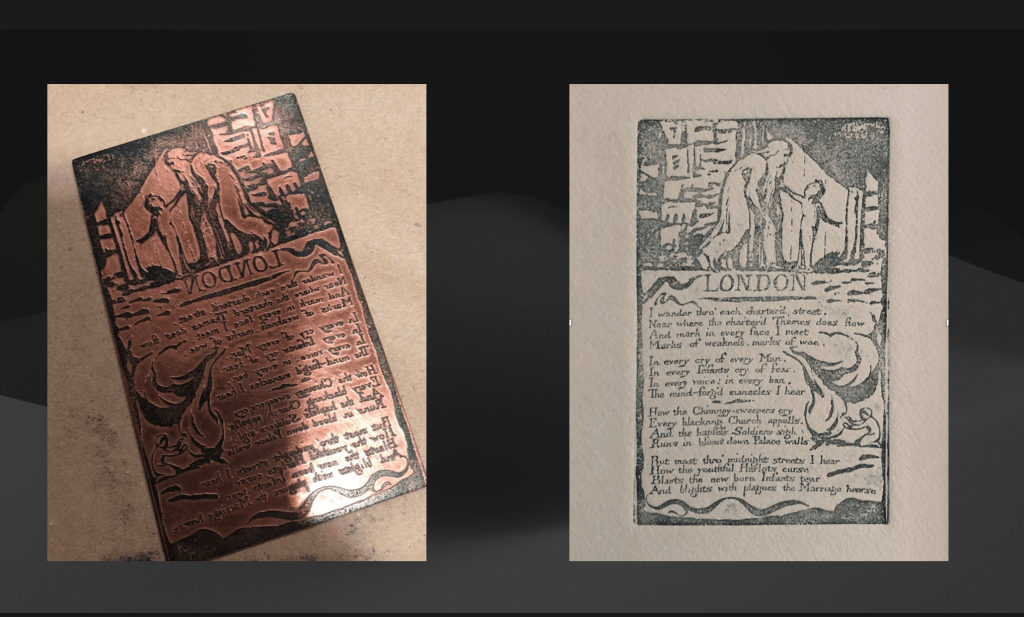
[Slide 6] I took my completed plate to be printed on Phillips’s press, which replicated every one of Blake’s components. The most obvious was a giant star wheel composed of four long handles. I turned this counterclockwise when pressing a new plate onto paper, which had been soaking previously in water to ensure that it absorbed as much ink as possible. The paper was placed onto the press bed with the copper plate and multiple layers of cloth were placed on top to control the pressure of the print when it moved through an upper and lower roller. I, then, removed the cloth and the plate to uncover the finished print. Every one of the prints turned out slightly differently, which materially reinforced what I had heard from many Blake scholars: that illuminated printing embraces the accidents and spontaneous differences that are a part of the process. While Mike Goode points out that the proverbs in The Marriage of Heaven and Hell decompose and reappropriate themselves into a variety of contexts, I could see a version of this decomposition and transformation happening before my eyes when I ran each page through the rollers. They were Blake’s, and also Phillips’s, and also mine.
As I refined my techniques, I inked a much more interesting version of Blake’s poem ‘LONDON’, which I have since framed as a monochrome and placed on my wall. It’s probably the most unique and valued image I own.
[Slide 7] When considering the question of whether Blake would have used a 3d-printer, William Smith quickly dismisses the idea. “[Blake] was a very physically-engaged, hands-on engraver and while he was an expert with the artistic technology of his day, he was clearly not a ‘data analyst.’” It’s true that Blake had a critique of the “ratio of the five senses” and the empiricism of philosophers like John Locke. He created artist books, many of which were quite expensive to produce. So, the idea that he’d analyze variations of copies, like scholars in textual studies, does not seem to be something that accords with Blake’s techniques or his ideas about art.
[Slide 7] When considering the question of whether Blake would have used a 3d-printer, William Smith quickly dismisses the idea. “[Blake] was a very physically-engaged, hands-on engraver and while he was an expert with the artistic technology of his day, he was clearly not a ‘data analyst.’” It’s true that Blake had a critique of the “ratio of the five senses” and the empiricism of philosophers like John Locke. He created artist books, many of which were quite expensive to produce. So, the idea that he’d analyze variations of copies, like scholars in textual studies, does not seem to be something that accords with Blake’s techniques or his ideas about art.
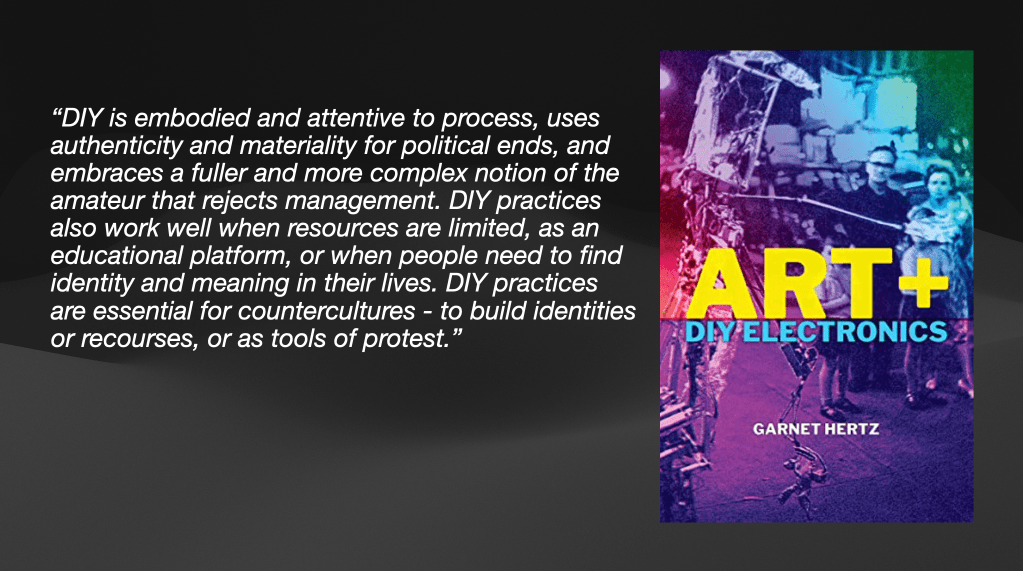
Given Blake’s emphasis on process, Blake might fit more readily into Garnet Hertz’s idea of a DIY artist. Hertz mentions the notion of DIY Electronic Art as a replacement for what he previously called “critical making.” For Hertz, DIY “is embodied and attentive to process, uses authenticity and materiality for political ends, and embraces a fuller and more complex notion of the amateur that rejects management.” All of these ideas link DIY practice to “an undercurrent of experimentation” that emphasize the aesthetic use of such technologies over archival ones. At the same time, the work of Courtney Jacobs, Marcia McIntosh, and Kevin M. O’Sullivan suggests that so-called makerspaces can also be used to support the production of archival deliverables for book history or “a work of enduring value, [in such an instance] particular attention must be given not only to the design and manufacturing of the product, but also to its metadata and sustainable long-term storage.” Given these different aims, how might we encourage more artistic / hands-on / physical engagements with his art in scholarship or in our teaching?
Paralleling these two different aims and two different approaches, I’m proposing two different but interrelated projects. The first might be considered archival, and link more directly with previous attempts to archive Blake’s work, like The Blake Archive and Nelson Hilton’s Blake Digital Text Project. One project involves the digitization of Blake’s plates as 3d-models in CAD [computer-aided design] software – with relevant metadata and a long-term storage. As Jacobs’s et al., argues by showcasing the use of 3d-printed versions of Pietro Mattoli’s woodblocks and blocks from The Diamond Sutra, these versions can offer information about these books as objects that are largely obscured from digital archives. Much like The Blake Archive expanded access to the reading of Blake’s art, I see this project as expanding access to artistic experimentation with and material appreciation of Blake’s plates.
The second project would dovetail with the first, enabling people to create variations of these digital files and artistically experiment with the plates themselves, while also archiving and documenting these creative responses. While variations and reproductions of Blake’s plates can be seen in many places, one example being the gorgeous mosaics produced of Blake’s work exist on display in Lambeth, there is little work online engaging with material reproductions of his plates. One exception is Jason Whittaker’s site Zoamorphosis and his work on Global Blake, which includes posts and videos about work in Blake criticism along with the reception of Blake’s art.
[Slide 9] Much has already been said about the mediated nature of the digital archive, perhaps the most famous of which occurred 20 years ago in 2003 when N. Katherine Hayles articulated the crucial material difference between “the print and electronic Blake.” Of course, this material difference may be even more pronounced when engaged in 3d printing. It is, for instance, extremely difficult to get printers to extrude fine lines. As I began conceptualizing this project, I consulted with Francesca Bessey, Program Coordinator for Gizmo-CDA – a makerspace in Coeur D’Alene, Idaho. She commented that replicating Blake’s writing would be difficult because “each line extruded by many 3d printers has to be at least .4mm thick. Which doesn’t sound like much, but it is when you’re trying to make text. […] There’s a reason people who make relief prints still do it by carving into wood, rubber, or linoleum.” She also mentioned being uncertain how ink would adhere to the plastics used in many 3d printers. Recall that the acid bite referenced by Viscomi was only .12mm thick. Exact replicas of Blake’s plates could be largely impossible to produce in 3d-printing, which may indicate why so few CAD models of Blake’s work have yet to appear. One of the few I found included reproductions of Blake’s painting “The Great Red Dragon and the Woman Clothed with the Sun,” from his Revelation Prints. Both the medallion and the larger statues are reminiscent of the print, but also have many differences from the original work.
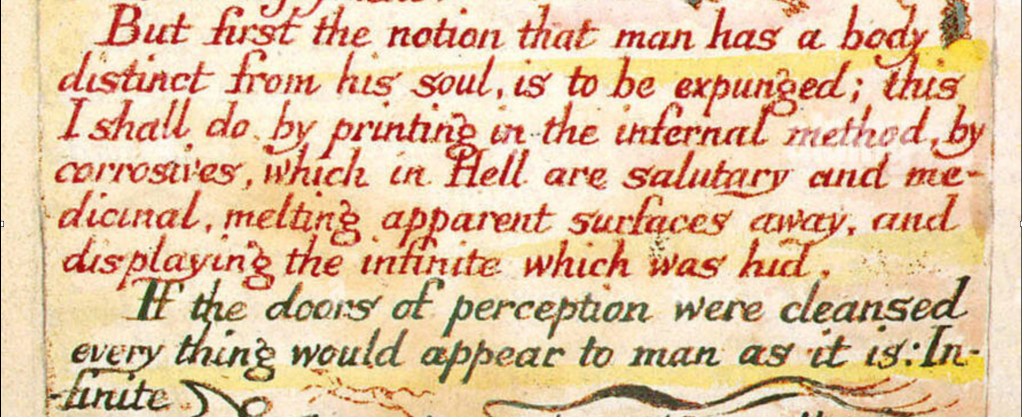
[Slide 10] This might be Blake’s revenge. After experiencing Phillips’s plates in the Fondren Library, it’s quite obvious that Blake’s mastery of technique is far beyond what most 3d-printers can accomplish today. In The Marriage of Heaven and Hell, Blake discusses “printing in the infernal method, by corrosives, which in Hell are salutary and medicinal, melting apparent surfaces away, and displaying the infinite which was hid.” By contrast 3D-printing is additive and mediated by computational modeling that reduces many of the objects being extruded to a ratio of numbers — something that Blake also abhorred.
Yet when considering the affection I hold for the print of London I produced, I suggest that our interaction with Blake can embrace the kinds of contradictions that emerge with any artistic appropriation. What would it mean for an archive to embrace material and artistic engagement as a way of understanding William Blake’s work? How do we distinguish between the reception of Blake’s work and the work itself? There was something new in my experience reprinting Blake at the Fondren Library: in the banal act of daubing ink on a copper plate for an hour and a half and in the surprising pleasure all of us expressed when a particularly beautiful or interesting print emerged from the press. We collectively wrestled with Blake’s ideas but also his materials, their resistance to the image of Blake’s work we had in our minds, and the tactile relationship to that experience w were developing in our bodies.
My memories of Blake and his prints are haunted by what Walter Benjamin calls ‘the time of the now’ (‘Jetztzeit’), in which the moments of my life and their association with Blake erupt into the histories I’m told through scholarly criticism. Blake is a strange figure to invoke when eulogizing the aura of an artwork. Mei-Ying Sung shows that the illuminated prints were already a copy of the original copper plates he engraved with his hands, and so subsequent reprintings contain an index to the past in the material force he used to create the engraving – even if someone else creates a new print from his plates. Conversely, when we remake Blake’s plates in the present, we’re confronted with a different index with this past: one focused less on materially tracing a connection between past and present and more in the nowtime occurring when we remake his techniques, images, or impressions now.
The use of artificial intelligence in writing is dramatically changing higher education. As someone who studies the impact of computing on literature, I am particularly aware that the writing process — as we’ve known it since at least the invention of the printing press — is changing forever. Many of my colleagues are concerned about the possibility for cheating among students, but it’s worth recognizing that these concerns are part of larger historical transformations that won’t go away any time soon.
ChatGPT (GPT refers to “Generative Pre-Trained Transformer”) is one of what are known broadly as LLMs, or large-language models. Also called generative AI, these are probabilistic models of natural language processing that generate text based on the statistical probability that one word will follow another. Another, less-well-known example of an LLM is Google Bard. It is worth noting that LLMs have many benefits. For instance, many students with disabilities, who speak languages other than English, or who are first-generation and unfamiliar with the conventions of academic English can find new forms of support with LLMs. Further, there are many ways ChatGPT could be used to supplement creative approaches for writing; for instance, writing in the style of a particular author.
I do not prohibit the use of ChatGPT in your writing. However, I will look for evidence of original thought in your work and grade against you if you use AI to replace your all of your thinking and interpretive work during the semester. I suggest that you document all use of ChatGPT when you use it. One way to do this would be to add a link to the interaction transcript that ChatGPT generates when it is used. Consider that the most important part of reading and writing is processing and developing an intellectual response to the works we read, thereby developing what pedagogue and activist Paulo Freire calls “critical consciousness.” That’s very difficult to do if an AI is doing all of the work for you. At the very least, you deprive yourself of the opportunity to develop your critical awareness of the world; yet, you may also be manipulated by the proven bias inherent in algorithms. See for instance, the work of Cathy O’Neil, Ruha Benjamin, and Shea Swauger. I would particularly recommend the 2020 film Coded Bias, for those of you who want to know more about algorithmic bias.
Consider the following facts about ChatGPT:
To create an account for OpenAI, you must provide personally identifiable information like an email/phone number/or Google Account.
When you use ChatGPT, you are providing free labor to OpenAI’s product development. They mention this on their FAQ page.
It is quite possible that AI will dramatically change the job landscape in the near future, including jobs you may want to have.
OpenAI exploits global labor, often traumatizing low-paid workers who are forced to review disturbing passages of hate speech and violence as examples to help the AI prevent the use of such speech on the app. Much of this work is done by refugees or people living in Kenya or the Phillipeans who will accept the $1-4/day salary offered by OpenAI.
[CAPS] [M] Advanced Topics in Literature 3 May be repeated for credit; cumulative maximum 6 hours. Course Prerequisite: Certified major in English; junior standing. Seminar with term paper project; focused studies in American, British, or global literatures.
Course Description
Lewis Mumford argues in Technics and Civilization that “[t]he clock, not the steam engine, is the key machine of the modern industrial age.” From deep time to time synchronization, computer timing to urban acceleration and general and special relativity, modern life is characterized by a multiplication and layering of temporal infrastructures that increasingly govern our lives. Temporal infrastructures work in tandem with the coding of bodies to unevenly repeat the rhythms of cultural hierarchy: black bodies can be coded as slow or ‘out of sync’ with modernity, while differently-abled bodied can be subjected to futurist fantasies of technological solutionism. This course explores how media and fiction work dialectically to produce different speeds, rhythms, frequencies, and scales of temporality. For instance, HG Wells’s The Time Machine is seen as the first machining representation of time travel, but this novelty is juxtaposed by Wells’s anxieties about the finitude of white supremacy when compared with the endless expanses of evolutionary biology. Requirements include two presentations, weekly Reading Notes, and a final multimodal project.
Schedule
Assignments Are Due On Date Listed. Schedule May Change with Notice from Me. Some of the links connect to WSU’s canvas site and are not accessible to people who have not enrolled in the class and are not signed into canvas.
Class
In-Class Learning Experiences
Texts Due
Assignments Due
T: 8/22
Quotes about science fiction and time travel from: Darko Suvin, Frederic Jameson, Samuel Delany
Look up the following from the Dictionary of Philosophical Untranslatables : Entstellung, Eternity/Duration/Aion/Chronos, Jetztzeit, Memory, Moment, Present, Stimmung, Time. (Warning: Large pdf file).
Reading Notes from me.
T: 8/29
NO CLASS
Th: 8/31
Think, Pair, Share:Why does Wells call his books “scientific romances?” Think about the romance as a genre and its connection to science fiction and time travel.
HG Wells, The Time Machine
Reading Notes 1: By midnight Wednesday post four questions, four quotes, and four takeaways from the reading for discussion.
T: 9/5
Think, Pair, Share: How does HG Wells adopt or appropriate Darwin’s work? How does he address the problem of narrative in terms of evolution that Beer lays out?
Wells appendix B and D in the Broadview Edition (“The Evolutionary Context: Society”; “The Spatiotemporal Context: The Fourth Dimension”
Adaptation: How do the beginnings of the novel and the show differ? Does this show enhance the novel or are there places where it falls short of the novel’s vision?
Think, Pair, Share: What different takes on the Butterfly Effect do we get from Carruth and Bradbury? What’s the connection between time travel and the short story? film?
Think, Pair, Share: Philosopher Martin Hagglund has argued that the only real freedom we have as human beings is to decide what to do with our limited lifetime. How does In Time literalize some of the ways we use capitalism to give the rich more time at the expense of the poor?
Think, Pair, Share: Consider the difference between playing a game and time and time in narrative. How does this game and Jason Shiga’s graphic novel exemplify such differences?
Think, Pair, Share:We’ve read several works this semester that connect time travel to machines and communication. How does the circular temporality of Arrival complicate how other stories viewed this connection?
This is my abstract proposal for the 2023 conference of The Association for the Study of the Arts of the Present, titled “Arts of Fugitivity,” occurring in Seattle WA on 4-7 October 2023.
A 2019 New Yorker profile William Gibson acknowledged that he had to rewrite the ending of his novel Agency several times due to the outcome of the 2016 election and Trump’s nuclear standoff with North Korea. Gibson’s attempt to forecast a dystopian future had been superseded by our own present dystopia that had become too real. Amazon also released a streaming adaptation of Gibson’s previous novel The Peripheral in 2022. The narrative of the streaming series departed in such significant ways from Gibson’s original novel that it caused many fans to call it a “stub,” a word from the novel referring to one of many alternate histories stored on a computer server in China. The central scenario of the two novels features the communication between these alternate histories through digital interfaces and computer peripherals: technologies that process algorithms in radically different ways than human beings experience time. Calling such processes “fugitive temporalities,” I suggest that Gibson is diagnosing the temporal politics of our current era only too well. As media archaeologists like Siegfried Zielinski and Wolfgang Ernst put it, we exist in a series of asynchronous temporal frameworks mediated by our devices, our internet networks, and our cultural politics. In fact, Gibson’s novel so powerfully describes these infrastructures that it may already render itself dated as a result.
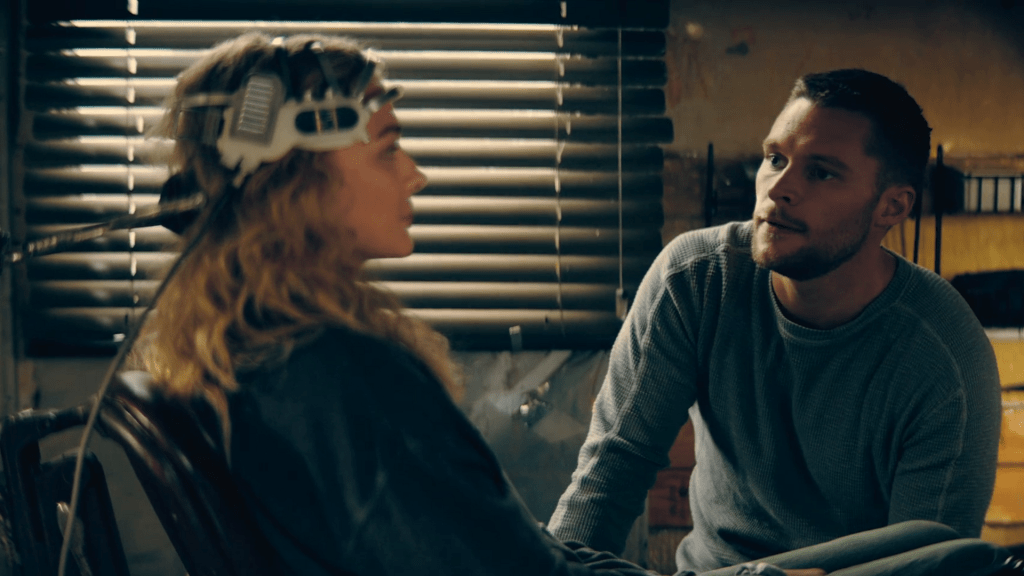
Burton Fisher (Jack Reynor) speaks to Flynne Fisher (Chloë Grace Moretz) in The Peripheral.
The streaming series introduces us to VR headsets, 3d printers, and the ubiquity of gamification; none of which point to significant technological innovation beyond minor design tweaks to existing devices. During my first read of Gibson’s 2014 novel, I was particularly struck by his description of the “wheelie-boy:” a proto-peripheral device consisting of an iPad mounted to a set of wheels. I’d just seen a 2016-episode of The Good Wife, in which a lawyer uses a telepresence robot to participate remotely in a meeting with the firm’s partners. And after COVID-19 forced people onto Zoom in one of the largest remote working experiments ever conducted, the cognitive estrangement offered by Gibson’s “wheelie-boy” seems almost quaint.
Yet the scenario of the novel also defamiliarizes our present. On the level of narrative as and as a transmedia experience, The Peripheral destabilizes how we understand the role of history and time in narrative as well as the link between media, data, and the Real. This piece will show how the streaming show’s depiction of these events questions what it means for science fiction to be realistic, particularly given the processing algorithms of streaming media — like file compression and data transmission.
ENGL 561 Studies in Technology and Culture: Examination of key concepts, tools, and possibilities afforded by engaging with technology through a critical cultural lens. (Crosslisted course offered as DTC 561, ENGLISH 561).
This course will act as an introduction to the multidisciplinary field of media archaeology, which studies the residual forms and practices of media as a critique of contemporary media culture. Focusing particularly on quirks, accidents and haphazard inventions, media archaeology imagines alternate histories and futures of technologies. Additionally, it combines these cultural histories of technology with a focus on the media operative capabilities of time-critical devices and geological and environmental phenomena to demonstrate how media process our experiences of history and temporality. While this course begins with central readings in the field — including Jussi Parikka’s survey of the variantologies of media practice in What is Media Archaeology?, Siegfried Zielinski’s call for “anarchaeological” attention to the curiosities of media history in Deep Time of the Media, and Wolfgang Ernst’s argument that operative media technologies “short circuit” through media history — we will pivot to explore some of the ways media archaeological investigations have been applied to and complicated by a variety of topics: racist infrastructure and surveillance, cybernetics and critical theory, guerilla warfare in the 1970s, and environmental humanities and extractive visualization technologies.
In terms of the latter, we will explore so-called operative images, images that were never intended to be seen by human beings but used in machine automation and artificial intelligence, along with their complicity in the so-called ‘extractive view’: what Macarena Gomez-Barris identifies as a nexus of “colonial paradigms, worldviews, and technologies that mark out regions of ‘high biodiversity’ in order to reduce life to capitalist resource conversion.” Requirements include two presentations, weekly text responses, and a final project that can take the form of a seminar paper, digital project, or pedagogical intervention.
Lewis Mumford argues in Technics and Civilization that “[t]he clock, not the steam engine, is the key machine of the modern industrial age.” From deep time to time synchronization, computer timing to urban acceleration — the history of modernity is characterized by a multiplication of what Axel Volmar and Kyle Stine call temporal infrastructures. Temporal infrastructures are assemblages of practices, technologies, institutions, and ecologies that manage, capitalize, and operationalize time. The result is a layering of temporal scales within and between the devices, systems, and environments that increasingly govern our lives. Temporal infrastructures work in tandem with the coding of bodies to unevenly repeat the rhythms of cultural hierarchy: black bodies can be coded as slow or “out of sync” with modernity, while differently-abled bodies can be subjected to futurist fantasies of technological acceleration. These infrastructures are what Wolfgang Ernst calls “time machines” in the media archaeological sense, since their materials and logistics process and code temporality. Time machines as they appear in science fiction dramatize how mediated experience recontextualizes the interplay between personal experiences of time, social realities shared through policed simultaneity, and the longue durées opened up by geological and cosmic speculation.
The course explores how media infrastructure and fiction work dialectically to produce different speeds, rhythms, frequencies, and scales of temporality. For instance, HG Wells’s The Time Machine is seen as the first machinic representation of time travel, but this novelty is juxtaposed by Wells’s anxieties about the finitude of white supremacy when compared with the endless expanses of evolutionary biology. On the other hand, NK Jemisin narratively exploits very similar deep temporalities in The Fifth Season, using their vertiginous perspectives to ask fundamental questions about race, hetero- and mononormativity, and privilege. In addition to exploring the social and technological implications of time travel, this course will also draw from critical race theory, feminism, queer theory, and eco-criticism to show how infrastructures use temporality to automate various privileges and oppressions. In addition to presentations on research and course content, this course requires a substantial final project that can take the form of a seminar paper, digital / multimodal project, lesson plan, or some other equivalent modality. Some possible texts include:
HG Wells, The Time Machine
NK Jemisin, The Fifth Season
Octavia Butler, Kindred
William Gibson, The Peripheral
Kim Stanley Robinson, The Years of Rice and Salt
Amal El-Hohtar and Max Gladstone, This is How You Lose the Time War
Neon Yang, The Genesis of Misery
Lauren Beukes, The Shining Girls
Analee Newitz, The Future of Another Timeline
Cixin Liu, The Three Body Problem
Louise Erdrich, Future Home of the Living God
Theoretical Texts include Selections From:
Lewis Mumford, Technics and Civilization
Christina Sharpe, In the Wake: On Blackness and Being
Rob Nixon, Slow Violence and the Environmentalism of the Poor
Jussi Parikka, A Slow Contemporary Violence
Wolfgang Ernst, Sonic Time Machines
Yuk Hui, Recursivity and Contingency
Amit Rai, Jugaad Time: Ecologies of Everyday Hacking in India
Kara Keeling, Queer Times, Black Futures
Elizabeth Freeman, Beside You in Time: Sense Methods and Queer Sociabilities in the American Nineteenth Century
Ruha Benjamin, Race After Technology: Abolitionist Tools for the New Jim Code
ENGL 561: Studies in Technology and Culture: Media Archaeology
This course will act as an introduction to the multidisciplinary field of media archaeology, which studies the residual forms and practices of media as a critique of contemporary media culture. Focusing particularly on quirks, accidents, and haphazard inventions, media archaeology imagines alternate histories and futures of technology. Additionally, it combines these cultural histories of technology with a focus on the media operative capabilities of time-critical devices and geological and environmental phenomena to demonstrate how media process our experiences of history and temporality. While the beginning weeks of the course focuses on canonical writings, like Walter Benjamin’s examination of the transformation of artworks when subjected to technological reproduction and Marshall McLuhan’s elucidation of media as extending the human sensorium; the majority of the course applies Benjamin and McLuhan’s focus on media materiality to range of subjects often not explicitly associated with media archaeology, but the course will show how these texts provide crucial interventions into a field that is often too centered on white and European theoretical traditions. These include: racist infrastructure and surveillance, cybernetics and critical theory, environmental humanities and animal phenomenology, and revolutionary politics and guerilla tactics. Course requirements include two presentation and a seminar paper, or digital or pedagogical project.
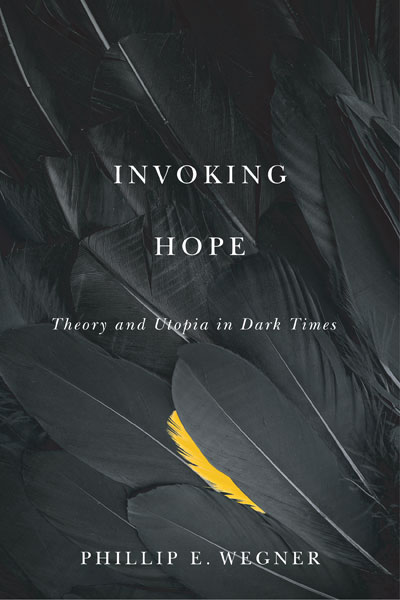
Cover of Philip E. Wegner’s Invoking Hope: Theory and Utopia in Dark Times (U Minnesota Press, 2020)
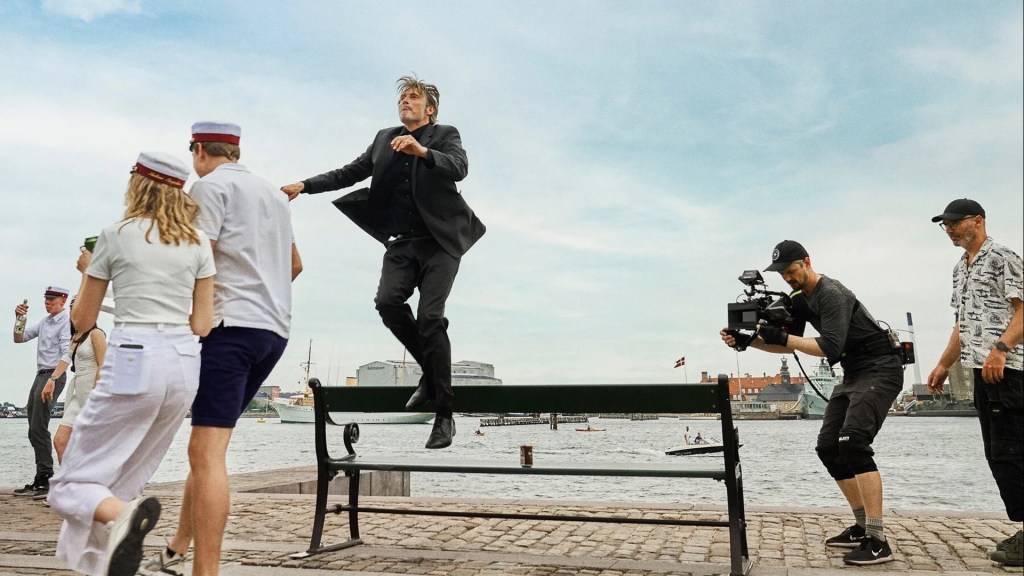
As I was finishing my reading of Phil Wegner’s Invoking Hope: Theory and Utopia in Dark Times, I watched Thomas Vinterberg’s film Druk (2020). The Danish title literally refers to “binge drinking” but, due to the moralistic context of the phrase in English, is translated for American audiences as Another Round.Druk features Mads Mikkelsen as a middle-aged history teacher named Martin who once had hopes of becoming a University professor, but has instead settled into what’s become a largely unrewarding position at a Gymnasium in Copenhagen. At the 40th birthday party of his friend, Martin learns of the work of real-life philosopher Finn Skårderud who argues that human beings are born with a blood-alcohol level (BAC) that is .05% too low for optimal happiness, creativity, and relaxation. Martin and his friends decide to maintain a constant elevated BAC during the day to see if it makes them happier. The experiment initially succeeds, but quickly falls apart. Martin’s family worries that he is descending into alcoholism, his wife reveals that she’s having an affair, and Martin’s friend and co-participant in the experiment dies while drunk on a boat with his dog. Even so, the film ends on a strangely celebratory note, with Martin and his friends joining in on the semi-drunken post-graduation celebrations of their students. The ambiguous denouement of Druk features Martin performing a brilliant dance routine that, in theapt words of a Vulture reviewer “offers an ecstatic reminder that someone may not still think of himself as a dancer, but that doesn’t mean he’s forgotten how to dance.”
Mads Mikkelsen dances at the climax of Thomas Vinterberg’s Druk (2020)
I kept thinking about that strange ending of Druk as I considered Wegner’s work on the necessity of utopia in difficult times and its contextualization in, as Wegner quotes Crystal Bartolovich, imperatives in critical theory to “scale back, pare down, [and] reclaim our disciplinary territory and hold on to it” (2). Druk invokes a very different sense of utopia than many of the sources in Wegner’s book. It’s hardly unknown that a significant percentage of University professors and students are high-functioning alcoholics — due perhaps to the combination of overbearing administrative oversight and standardized testing and performance review that are the hallmarks of the neoliberal University. Yet instead of engaging in what Wegner calls a “moralistic criticism,” Druk perversely uses alcohol to engage in various experiments in solidarity and utopia. One of the more uncomfortable, but also unique, moments in the film for this American viewer involves a teacher offering his student a small amount of alcohol to calm him down in order to take his test. In this context, and instead of reclaiming disciplinary territory, the final scene is a dramatic representation of the possibilities involved in constructing spaces of creativity and inclusion in the midst of social and personal trauma.

 Roger Whitson