[Slide 1] Much of this talk is a preliminary reflection on a project I’m currently in the process of conceptualizing. I caused a bit of a stir in 2013 at the National Association for the Study of Romanticism (NASSR) when I admitted that I had never gazed upon one of Blake’s original works. It felt like a scandal. I signed up for the “Blake printing workshop” put on for NASSR 2023 by William Brewer, Alexander Reiger, and Thora Brylowe at Rice University’s Fondren Library in order to gain a more tactile appreciation of Blake’s work. In addition to recounting my experiences there, I’d like to briefly discuss a broader project I’m in the preliminary stages of planning regarding Blake’s plates and digital reproduction.
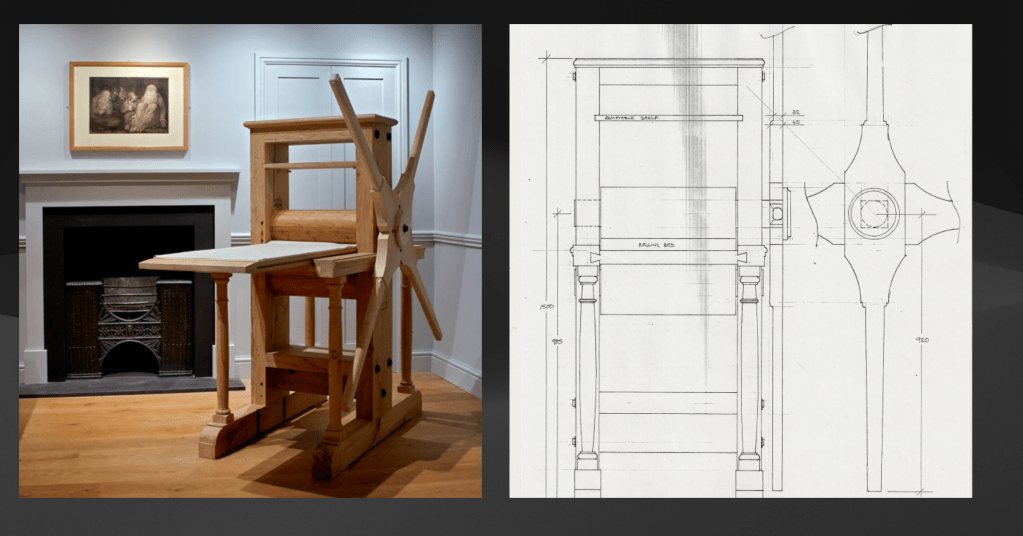
[Slide 2] The “Blake printing workshop” featured Michael Phillips’s replica of Blake’s eighteenth-century printing press and his remakes of Blake’s copper plates. The star-wheel press had been housed at Oxford University for years, until it was acquired by Rice University in March 2023 — only a few weeks before I saw it. Philips collaborated with Bates and Lambourne furniture makers (BLAM) to create a replica of Blake’s star-wheel press. The furniture makers were originally presented with reclaimed materials, including the former bell frame of St. Mary’s Church, High Wycombe. They recount the many problems that can emerge with reclaimed materials: “[E]ven new planks can hide all manner of metal shrapnel, occasionally literally, but also the odd staple that held the barbed wire that the tree grew round, and not unusually the shotgun pellets that missed the pheasant. Trees have a way of consuming history; our timber merchant claims they once had a trunk that contained an entire bicycle within its knotty entrails.”
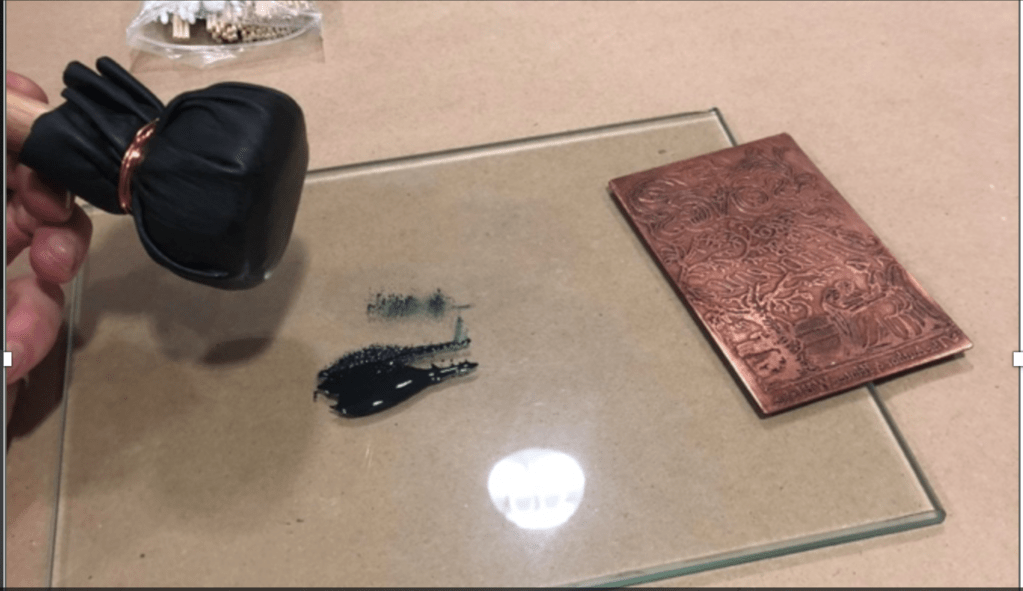
[Slide 3] I spent about three hours with the replica, much of it mixing ink, applying the ink to plates using a ‘dauber,’ then printing the plates onto paper with Philips’s press. Of course, we did not have time to etch or engrave the plates themselves, since that would have taken much longer. Joseph Viscomi mentions that the “ink” applied to the plates was likely made out of resin and turpentine mixed with linseed oil, what many etchers call “stop out varnish,” which is “used to paint over lines and areas to ‘stop’ them from being bitten deeper by the acid. By biting a design multiple times and stopping out different lines and areas each time, the etcher varies the depths of the intaglio lines and thus their tonality, creating the illusion of aerial perspective and modeling.”
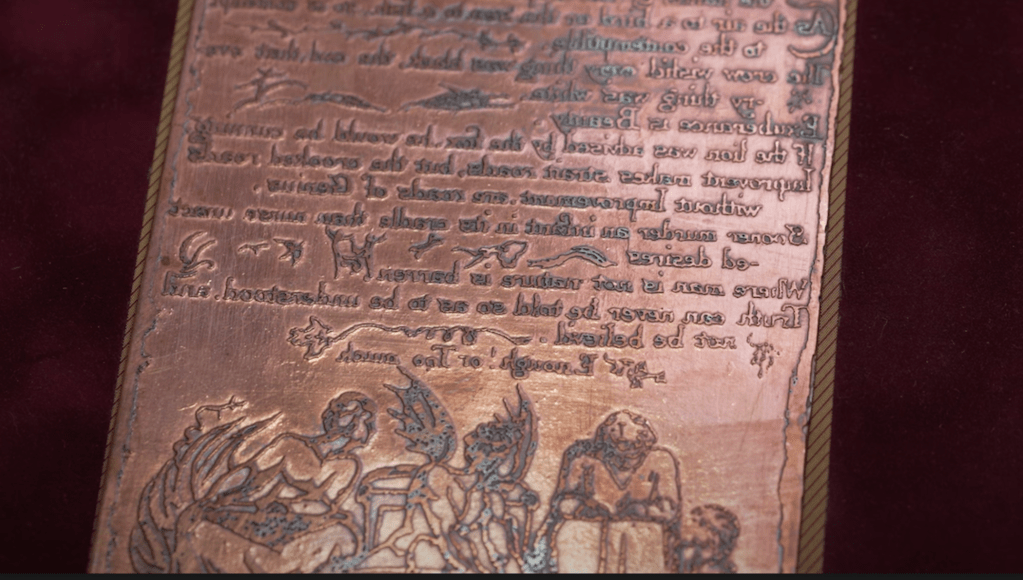
[Slide 4] I quickly noticed the incredibly small size of the words etched into the copper plates. Take a look at a quick close-up of a plate from The Marriage of Heaven and Hell to get a sense of the size .Philips reports that Blake’s method of etching creates reliefs that are almost microscopic in the depth that is created by the application of nitric acid: “[A plate from America: A Prophecy, for instance] was etched in two stages to prevent underbiting, first to 0.05 mm. followed by a further 0.07 mm., the total depth of bite amounting to no more than 0.12 mm.” The delicate bite relief created through this method has implications for attempts to reproduce Blake’s prints in 3d printing, which we’ll return to later on.
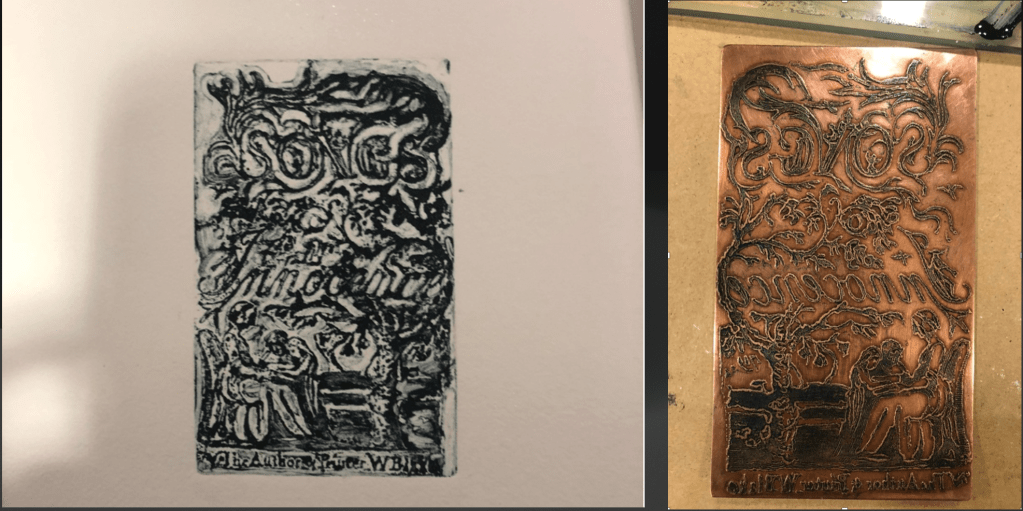
[Slide 5] My first attempt inking one of Blake’s plates on Phillips’s replica press was a total disaster. I chose the title page of Songs of Innocence, which depicts words of the title curling into branches and leaves. Blake’s title page is a variation of what medieval writers called an abecedary, in which letters of the alphabet formed out of common images were printed into books or carved into stone to help illiterate believers appreciate passages from the Bible. Blake uses the same technique to infuse his letters with a material and visionary intensity, as if the strenuous act of reading the text physically transforms our senses and helps us discover ‘the infinite in every thing.’
Producing such an intricate print as the Songs of Innocence title page made my discovery of Blake’s materiality much more tactile, technical, and material. Simple plates are relatively easy to ink, but the more complicated ones create more opportunities for smudges, misprints, or other errors. I was lucky that Brylowe, both a Blake scholar and a professional printer, inked another plate beside me and could act as a guide. To make the ink, Brylowe used bone black, yellow ochre, and Prussian blue and mixed these together with linseed oil. Brylowe instructed me to put as little ink onto the dauber as possible, and to lightly tape the copper plate with the dauber to build up several thin layers of ink. Phillips comments that inking “in this way can take up to two hours […], which may explain why so few copies of Blake’s work were produced.”
I clearly did not have Blake’s patience and failed to follow instructions. Not only did I put entirely too much ink on my dauber, I failed to apply the ink as delicately as needed for a good result. Blobs of ink bubbled up from the page and annihilated Blake’s delicate flora. I was humbled and given an even deeper appreciation of the craftsmanship behind Blake’s plates.
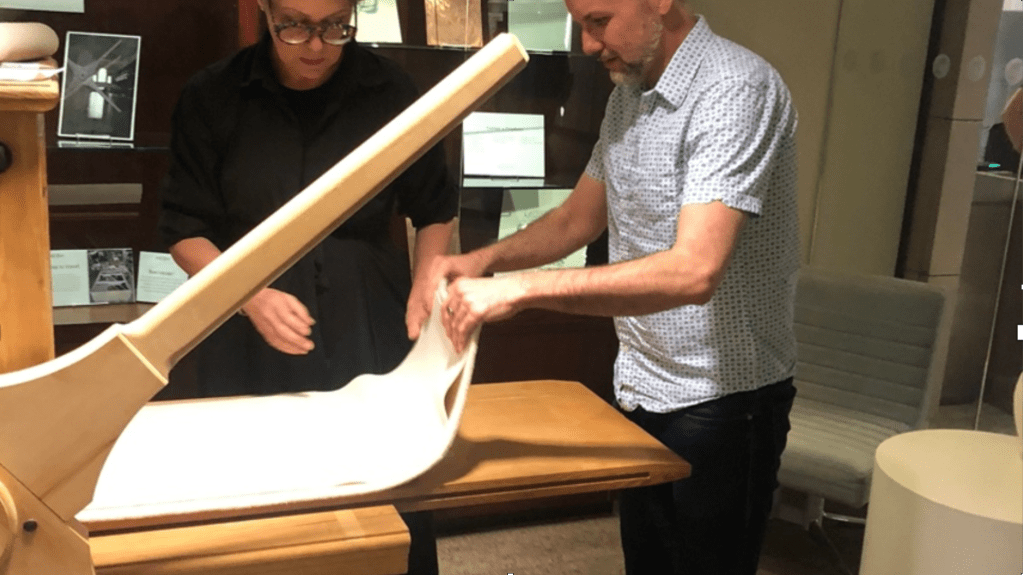
[Slide 6] I took my completed plate to be printed on Phillips’s press, which replicated every one of Blake’s components. The most obvious was a giant star wheel composed of four long handles. I turned this counterclockwise when pressing a new plate onto paper, which had been soaking previously in water to ensure that it absorbed as much ink as possible. The paper was placed onto the press bed with the copper plate and multiple layers of cloth were placed on top to control the pressure of the print when it moved through an upper and lower roller. I, then, removed the cloth and the plate to uncover the finished print. Every one of the prints turned out slightly differently, which materially reinforced what I had heard from many Blake scholars: that illuminated printing embraces the accidents and spontaneous differences that are a part of the process. While Mike Goode points out that the proverbs in The Marriage of Heaven and Hell decompose and reappropriate themselves into a variety of contexts, I could see a version of this decomposition and transformation happening before my eyes when I ran each page through the rollers. They were Blake’s, and also Phillips’s, and also mine.
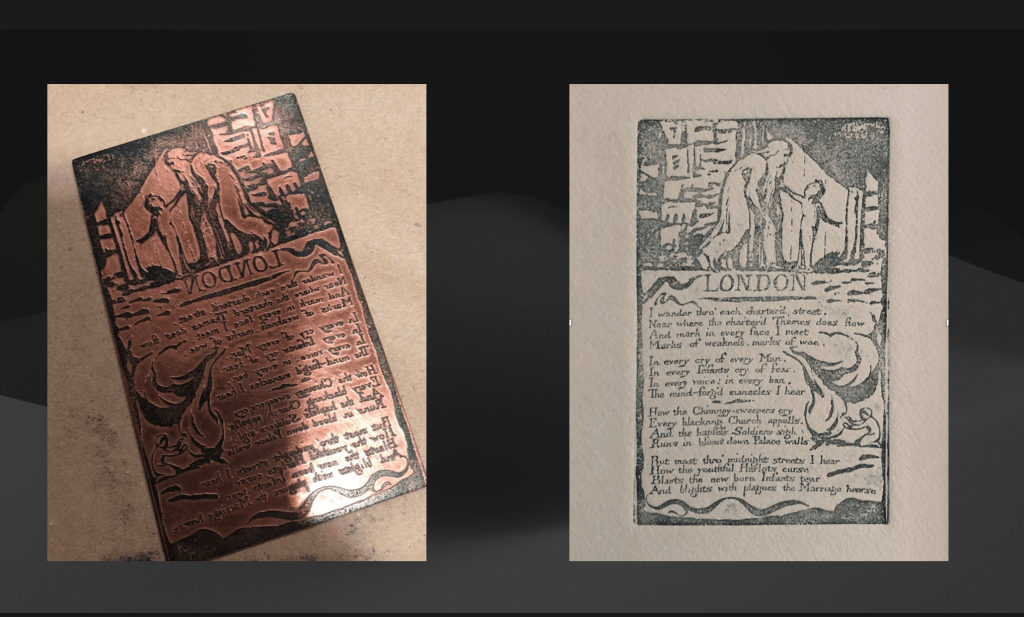
As I refined my techniques, I inked a much more interesting version of Blake’s poem ‘LONDON’, which I have since framed as a monochrome and placed on my wall. It’s probably the most unique and valued image I own.
[Slide 7] When considering the question of whether Blake would have used a 3d-printer, William Smith quickly dismisses the idea. “[Blake] was a very physically-engaged, hands-on engraver and while he was an expert with the artistic technology of his day, he was clearly not a ‘data analyst.’” It’s true that Blake had a critique of the “ratio of the five senses” and the empiricism of philosophers like John Locke. He created artist books, many of which were quite expensive to produce. So, the idea that he’d analyze variations of copies, like scholars in textual studies, does not seem to be something that accords with Blake’s techniques or his ideas about art.
[Slide 7] When considering the question of whether Blake would have used a 3d-printer, William Smith quickly dismisses the idea. “[Blake] was a very physically-engaged, hands-on engraver and while he was an expert with the artistic technology of his day, he was clearly not a ‘data analyst.’” It’s true that Blake had a critique of the “ratio of the five senses” and the empiricism of philosophers like John Locke. He created artist books, many of which were quite expensive to produce. So, the idea that he’d analyze variations of copies, like scholars in textual studies, does not seem to be something that accords with Blake’s techniques or his ideas about art.
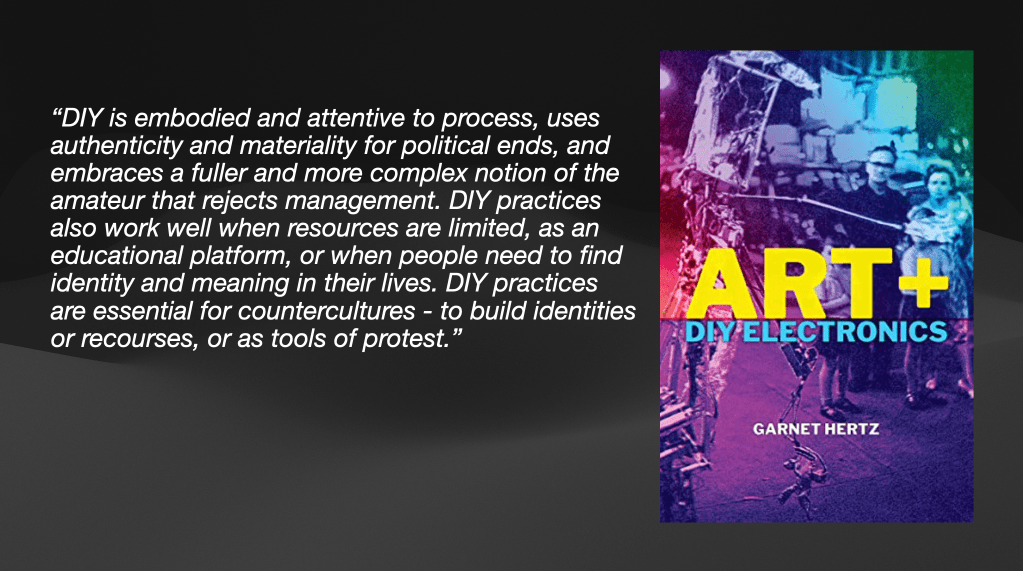
Given Blake’s emphasis on process, Blake might fit more readily into Garnet Hertz’s idea of a DIY artist. Hertz mentions the notion of DIY Electronic Art as a replacement for what he previously called “critical making.” For Hertz, DIY “is embodied and attentive to process, uses authenticity and materiality for political ends, and embraces a fuller and more complex notion of the amateur that rejects management.” All of these ideas link DIY practice to “an undercurrent of experimentation” that emphasize the aesthetic use of such technologies over archival ones. At the same time, the work of Courtney Jacobs, Marcia McIntosh, and Kevin M. O’Sullivan suggests that so-called makerspaces can also be used to support the production of archival deliverables for book history or “a work of enduring value, [in such an instance] particular attention must be given not only to the design and manufacturing of the product, but also to its metadata and sustainable long-term storage.” Given these different aims, how might we encourage more artistic / hands-on / physical engagements with his art in scholarship or in our teaching?
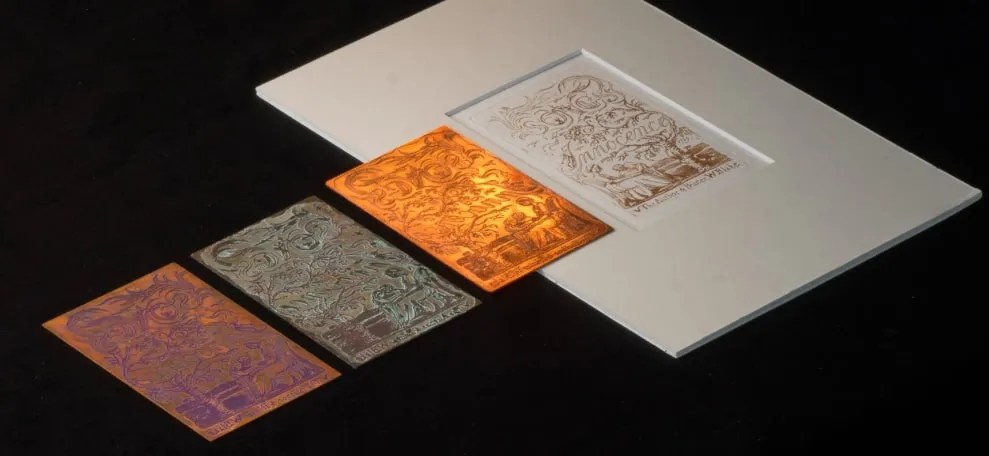
Paralleling these two different aims and two different approaches, I’m proposing two different but interrelated projects. The first might be considered archival, and link more directly with previous attempts to archive Blake’s work, like The Blake Archive and Nelson Hilton’s Blake Digital Text Project. One project involves the digitization of Blake’s plates as 3d-models in CAD [computer-aided design] software – with relevant metadata and a long-term storage. As Jacobs’s et al., argues by showcasing the use of 3d-printed versions of Pietro Mattoli’s woodblocks and blocks from The Diamond Sutra, these versions can offer information about these books as objects that are largely obscured from digital archives. Much like The Blake Archive expanded access to the reading of Blake’s art, I see this project as expanding access to artistic experimentation with and material appreciation of Blake’s plates.
The second project would dovetail with the first, enabling people to create variations of these digital files and artistically experiment with the plates themselves, while also archiving and documenting these creative responses. While variations and reproductions of Blake’s plates can be seen in many places, one example being the gorgeous mosaics produced of Blake’s work exist on display in Lambeth, there is little work online engaging with material reproductions of his plates. One exception is Jason Whittaker’s site Zoamorphosis and his work on Global Blake, which includes posts and videos about work in Blake criticism along with the reception of Blake’s art.

[Slide 9] Much has already been said about the mediated nature of the digital archive, perhaps the most famous of which occurred 20 years ago in 2003 when N. Katherine Hayles articulated the crucial material difference between “the print and electronic Blake.” Of course, this material difference may be even more pronounced when engaged in 3d printing. It is, for instance, extremely difficult to get printers to extrude fine lines. As I began conceptualizing this project, I consulted with Francesca Bessey, Program Coordinator for Gizmo-CDA – a makerspace in Coeur D’Alene, Idaho. She commented that replicating Blake’s writing would be difficult because “each line extruded by many 3d printers has to be at least .4mm thick. Which doesn’t sound like much, but it is when you’re trying to make text. […] There’s a reason people who make relief prints still do it by carving into wood, rubber, or linoleum.” She also mentioned being uncertain how ink would adhere to the plastics used in many 3d printers. Recall that the acid bite referenced by Viscomi was only .12mm thick. Exact replicas of Blake’s plates could be largely impossible to produce in 3d-printing, which may indicate why so few CAD models of Blake’s work have yet to appear. One of the few I found included reproductions of Blake’s painting “The Great Red Dragon and the Woman Clothed with the Sun,” from his Revelation Prints. Both the medallion and the larger statues are reminiscent of the print, but also have many differences from the original work.
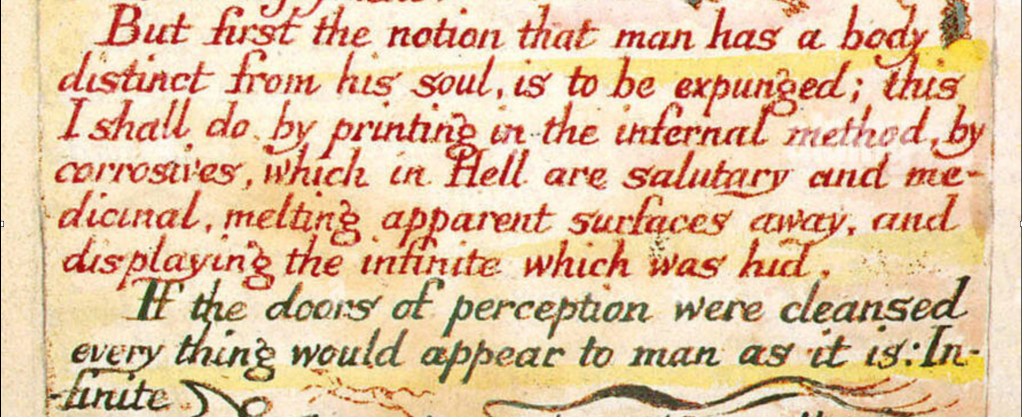
[Slide 10] This might be Blake’s revenge. After experiencing Phillips’s plates in the Fondren Library, it’s quite obvious that Blake’s mastery of technique is far beyond what most 3d-printers can accomplish today. In The Marriage of Heaven and Hell, Blake discusses “printing in the infernal method, by corrosives, which in Hell are salutary and medicinal, melting apparent surfaces away, and displaying the infinite which was hid.” By contrast 3D-printing is additive and mediated by computational modeling that reduces many of the objects being extruded to a ratio of numbers — something that Blake also abhorred.
Yet when considering the affection I hold for the print of London I produced, I suggest that our interaction with Blake can embrace the kinds of contradictions that emerge with any artistic appropriation. What would it mean for an archive to embrace material and artistic engagement as a way of understanding William Blake’s work? How do we distinguish between the reception of Blake’s work and the work itself? There was something new in my experience reprinting Blake at the Fondren Library: in the banal act of daubing ink on a copper plate for an hour and a half and in the surprising pleasure all of us expressed when a particularly beautiful or interesting print emerged from the press. We collectively wrestled with Blake’s ideas but also his materials, their resistance to the image of Blake’s work we had in our minds, and the tactile relationship to that experience w were developing in our bodies.
My memories of Blake and his prints are haunted by what Walter Benjamin calls ‘the time of the now’ (‘Jetztzeit’), in which the moments of my life and their association with Blake erupt into the histories I’m told through scholarly criticism. Blake is a strange figure to invoke when eulogizing the aura of an artwork. Mei-Ying Sung shows that the illuminated prints were already a copy of the original copper plates he engraved with his hands, and so subsequent reprintings contain an index to the past in the material force he used to create the engraving – even if someone else creates a new print from his plates. Conversely, when we remake Blake’s plates in the present, we’re confronted with a different index with this past: one focused less on materially tracing a connection between past and present and more in the nowtime occurring when we remake his techniques, images, or impressions now.
Thanks.


