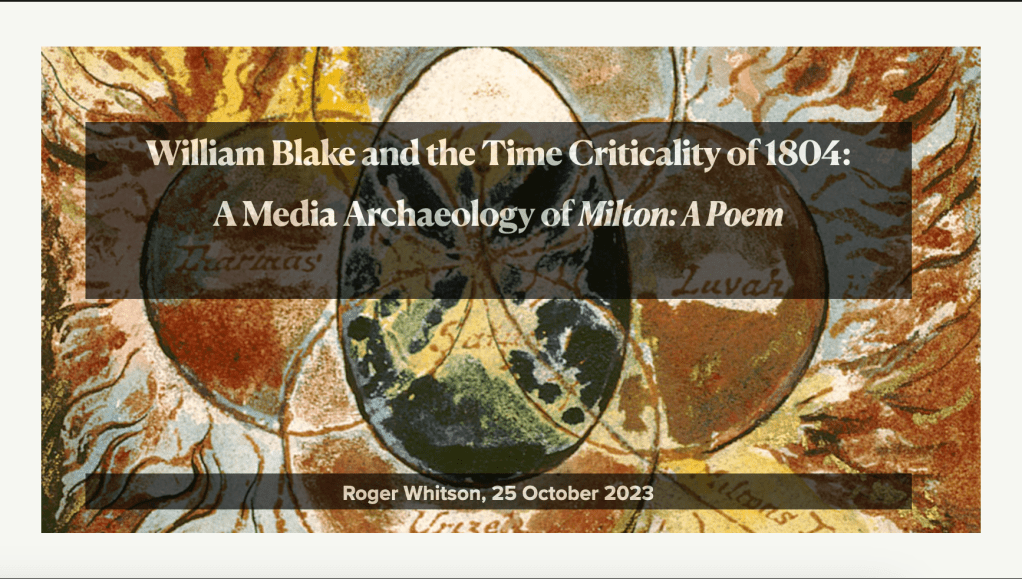
During their move to Felpham in 1800, the Blakes noted that among their luggage were “Sixteen heavy boxes & portfolios full of prints.” Biographer G.E. Bentley provides an expanded inventory of the “worldly goods” they brought with them:
Blake’s library; his notebooks, sketches, manuscripts such as An Island on the Moon, Tiriel, and Vala; watercolors; the proof copy of The French Revolution and the remaining copies of Poetical Sketches (at least fifteen); his copperplates and copies of his works in Illuminated Printing; blank paper; boxes of gravers, etching needles, wax, varnish, turpentine, and ink; and the crates for his printing press; not to mention clothing, cooking and eating utensils, and furnishings.
So many prints and plates loaded onto a cart, traveling through the country landscape, make for a strange and precarious temporal assemblage. The cart trailing the Blakes housed the completed manuscript portions of Vala, or the Four Zoas, one of Blake’s major works, along with sections that would later be reworked for Milton and Jerusalem. Work published prior to his move was also on the cart: fifteen copies of Poetical Sketches (which only had a print run of 50 copies), at least a single copy of all of the illuminated books produced up to that point in his life (some 14 different works including – among others – the Continental Prophecies, the Songs, and the Urizen books), and the instruments that he would later use to create prints, watercolors, and illustrations: chemicals, mechanisms, metal. We can also imagine the more banal items that supported Blake’s work — the food and furnishing which sustained his life — as mixed in, tied to, or shoved between the more recognizable artifacts of this strange archive in motion. What arrived to the Blakes’ residence on South Moulton Street on the cusp of 1804 must have been reminiscent of a media archaeological excavation site, with multiple scales ¬of temporality sedimented together and traveling through space and time.
[Slide 3] 1804 saw what many scholars believe to be the beginning of Blake’s composition process for Milton: A Poem. A central part of transformation in Milton is a renovation of time itself. As Claire Colebrook puts it, the poem Milton distinguishes between historical time and “what Blake describes as the eternity or vortex that opens from the smallest of particulars, but that is indiscernible to the localized observer.”For Mary Lynn Johnson, these vortices are best described as “warps in time, space, and consciousness” but she also compares them to “cinema-style jump-cuts, flashbacks, flash-forwards, and speeded-up and stop-motion replays,” suggesting that Blake’s work may have more in common with cinema than most Romantic poems. In fact Johnson’s cinematic language resonates with the interdisciplinary field of media archaeology in which the manipulation of temporality performed by cinematic montage is abstracted into a research method that can be applied to any medium. The field has its disciplinary roots not only in the computational histories of Friedrich Kittler, Wolfgang Ernst, and Jussi Parikka but also in scholarship describing the temporal complexities of the cinematic apparatus and especially the cinematic archaeology of C. W. Cerem, the movement and time images described by Gilles Deleuze, and the alternate histories of the cinema proposed by Thomas Elsaesser. Media archaeology is particularly important in understanding how Blake’s works in illuminated printing process time to generate particular depictions of time in Milton but also as Blake’s work shifts to new temporalities and materialities in various printed and digital editions.
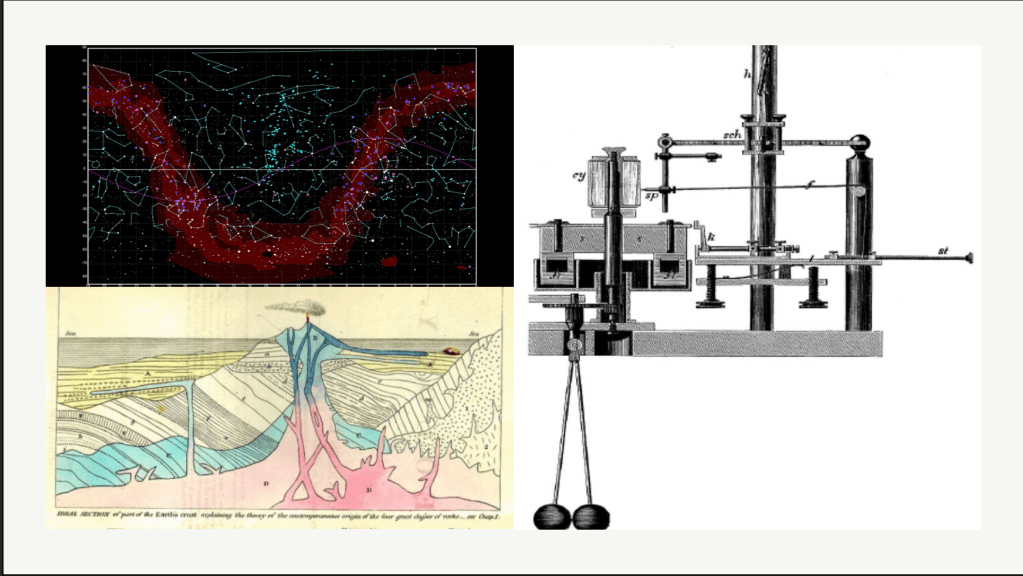
[Slide 4] Further, the experimental and theoretical underpinnings of media archaeology were developed under the sign of Romantic science, including James Hutton’s and Charles Lyell’s respective theories about deep time, William Herschel’s deep sky surveys, and Hermann von Helmholtz’s work on the temporal and physiological thresholds of sense perception. John Durham Peters argues that Romantic science and Romantic media were tightly intertwined, particularly since Herschel was intimately aware of the “signal and channel properties of the telescope.” As a concept emerging in dialogue with Romantic science, the vortex in Blake’s poem Milton exemplifies the emergent transformations of time occurring during his life, while Milton as an illuminated book also operationalizes temporal infrastructures in its production and reception. This talk attends to what Saree Makdisi calls the “gap between historical experience and history itself,” and elaborates in terms of the latter as “the rules and regulations – the laws – according to which historical experience is recorded and narrated” by demonstrating Blake’s own awareness of not only textual mediations of time but also how such mediations are constructed by cultural techniques of counting and the implementation of technological media that archive, play back, and engage in time-axis manipulation. First, I’ll look at Blake’s theory of the vortex in one of the more celebrated passages from Milton as a response to the emergence of time-critical media in the early Romantic period. Finally, I’ll offer some reflections on the poem’s digital materiality and recursive history by looking at their metadata, policies, and logistics in The William Blake Archive.
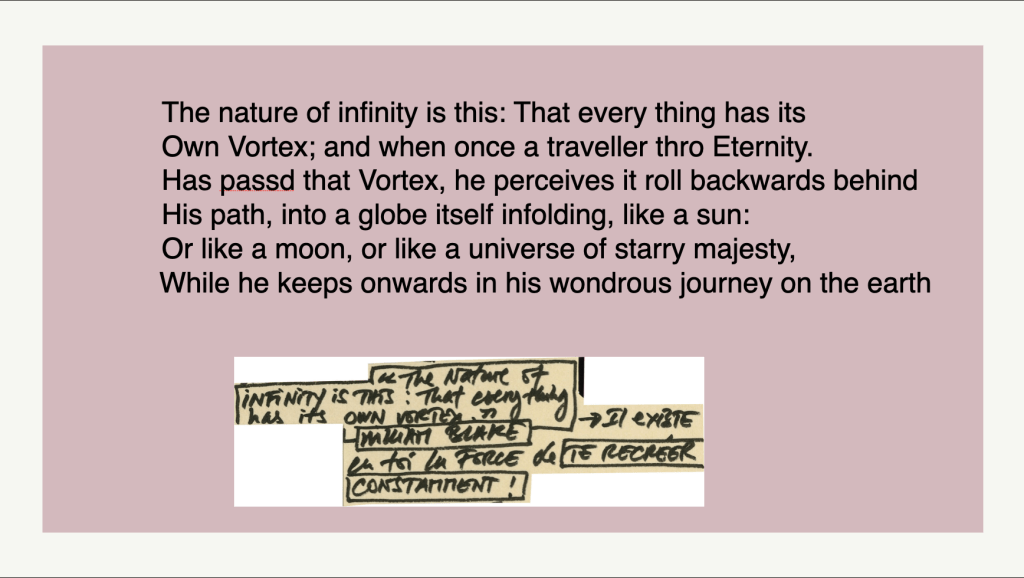
[Slide 5] One of the most celebrated passages in Milton describes Blake’s vortex, in which travelers pass from a finite space to a plane that opens itself onto Eternity:
The nature of infinity is this: That every thing has its
Own Vortex; and when once a traveller thro Eternity.
Has passd that Vortex, he perceives it roll backwards behind
His path, into a globe itself infolding, like a sun:
Or like a moon, or like a universe of starry majesty
While he keeps onwards in his wondrous journey on the earth
Blake also describes the Earth as “one infinite plane,” suggesting that this plane is infolded as the traveler moves through it. As several authors have shown, Blake’s vortex references Rene Descartes’s vortex theory of gravitation, which holds that planets, comets, and other stellar phenomena travel along bands of particles as they move across the solar system. Instead of existing in a void, as in Isaac Newton’s theory of gravitation, Descartes’s theory of gravity describes space as a plenum with vortices attracting celestial bodies much like physical objects circle around funnels. These bodies rest upon the vortex; consequently, the shape of the vortex provides each celestial body with its particular orbit. Emily Thomas calls Descartes’s vortices “akin to whirlpools or whirlwinds,” and argues that Descartes’s vortex theory is important because “it is the first early modern mechanist account aiming to explain the current state of the universe purely via matter” (47). As a material mechanism, Descartes’s vortex provides a powerful explanation for the movement of celestial bodies without referencing metaphysics.
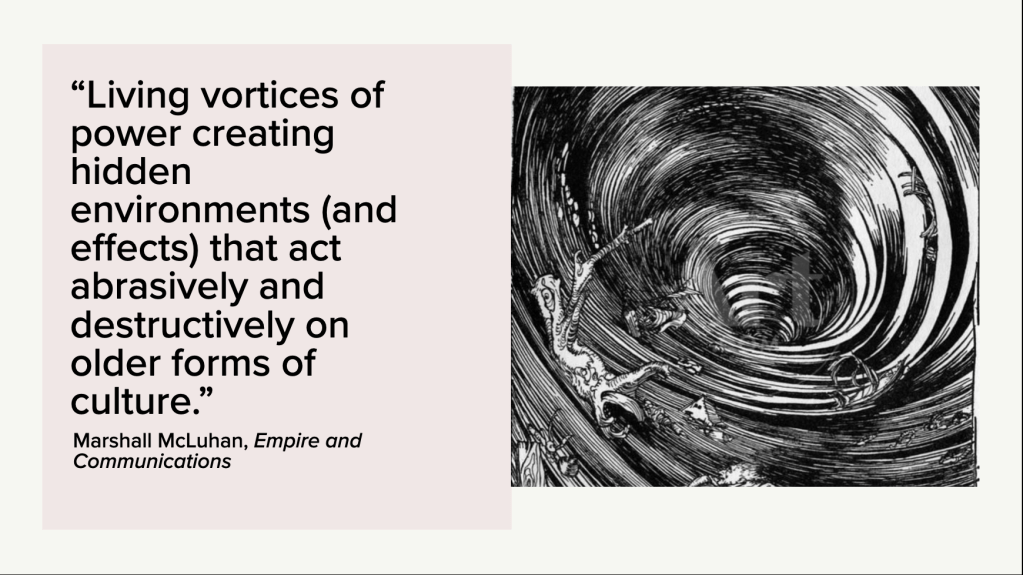
[Slide 6] Blake transforms Descartes’s mechanist account of the vortex into a media theory illustrating the dynamic interactions between philosophical systems, space, and time. This transformation challenges the industrial temporality of the early nineteenth century even as it also anticipates the recursive temporal structures of post-industrial capitalism. Accordingly, I look to the vortex in Blake’s Milton to underline the challenge such structures make to linear temporalities and to suggest that media archaeology’s readings of time were anticipated by Blake’s illuminated poetry. Blakean vortices are not planetary funnels but, rather, phenomenological ruptures in the fabric of space and time that transform them into heterogeneous, contiguous, and recursive structures. In the process, the vortex reveals the mediated experience of temporality, putting into relief the interconnections between perspective, subjectivity, and time. Blake sees media operating in a way similar to Marshall McLuhan’s description of them as “living vortices of power creating hidden environments (and effects) that act abrasively and destructively on older forms of culture.” McLuhan develops his idea through a reading of Edgar Allan Poe’s “A Descent into the Maelstrom,” in which a ship is caught in a hurricane-like vortex that accelerates the time and aging of the unlucky people on board. Yet as scholars like Andrew Burkett have pointed out, McLuhan’s work on media is also heavily indebted to Blake’s belief that his works can radically transform the experiences of people reading them. In this sense, Eternity, for Blake, is not a limitless space but a separate medium opened up by the vortex that interrupts homogeneous time. In the language of media archaeology, vortices act as operational shortcuts between linear moments of history.
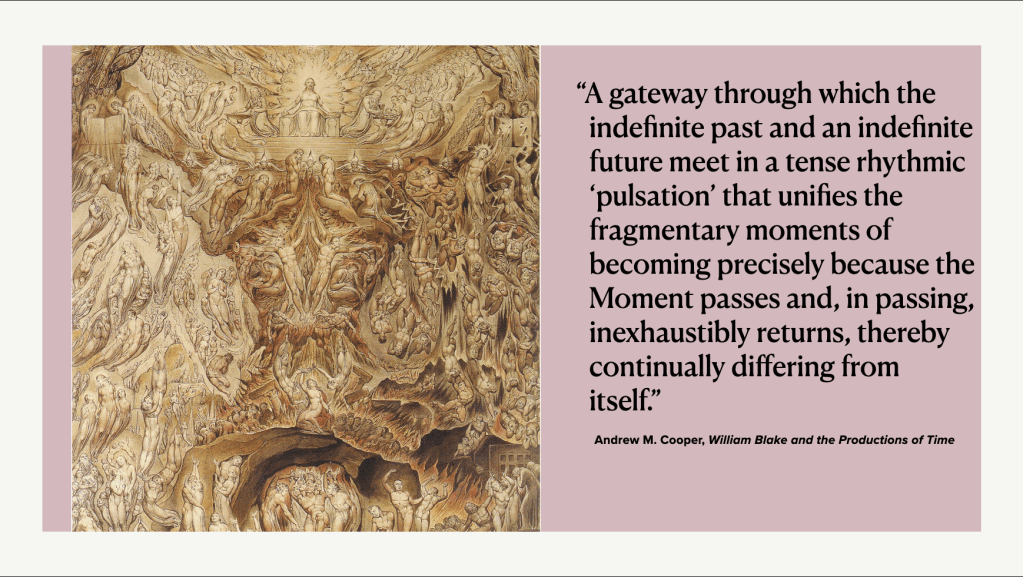
[Slide 7] Recursions in this passage reveals the coexistence of Eternity with the productions of time, suggesting a turn to time-critical analysis when devising an intervention into the temporal politics of the early nineteenth century. Explaining this coexistence, Andrew M. Cooper defines the Blakean moment as “a gateway through which the indefinite past and an indefinite future meet in a tense rhythmic ‘pulsation’ that unifies the fragmentary moments of becoming precisely because the Moment passes and, in passing, inexhaustively returns, thereby continually differentiating from itself.” Like Nietzsche’s Eternal Return of the Same and Gilles Deleuze description of differentiation from Difference and Repetition, the Blakean moment conceptualizes difference as that which produces individuality, similarity, and the Same. But even more importantly, the contradicting currents of the Blakean vortex resonate with controversies regarding the nature of time in Romantic science as well as the signal and channel properties of Romantic media – anticipating what we might call the recursive loops of cybernetics and post-industrial capitalism.
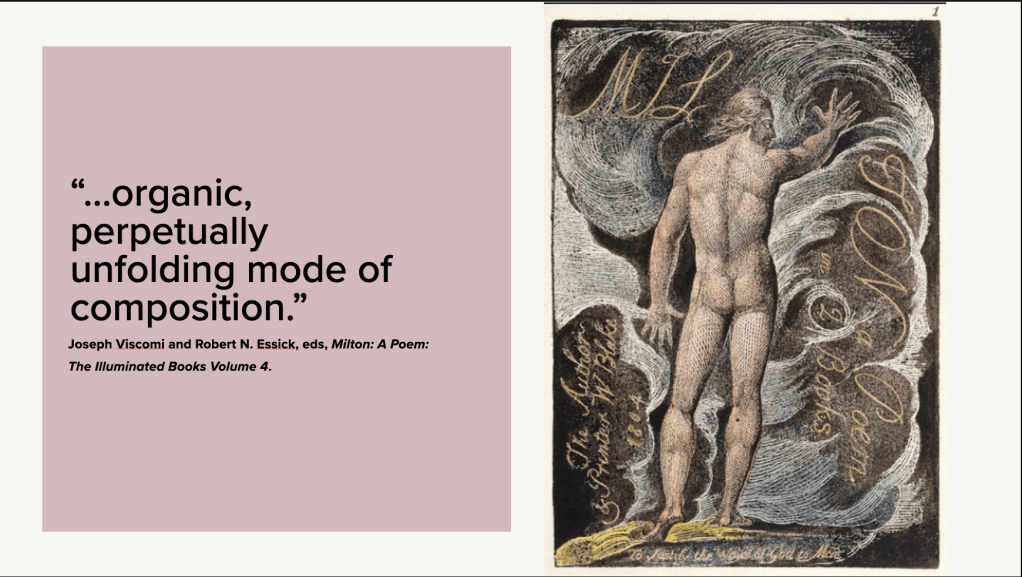
[Slide 8] These recursions happen not only in the poetic themes of Milton, but also in the controversies surrounding the date of its publication and digitization in The William Blake Archive. First, the metadata of the frontispiece of Copy C mention that “some of the poem might have been written before Blake left Felpham in the fall of 1803” and “[s]ome of the coloring may have been added as late as c. 1820,” hinting at the complicated publication history of the poem. In fact the many problems surrounding the dating of Copy C illustrate the complicated temporal assemblage at the heart of Milton’s media materiality: that both Milton and Jerusalem were initially composed as part of Vala, or the Four Zoas; that eventually the structural limitations of Vala could no longer hold the many ideas that kept being generated while Blake composed the poem; and that he split of the other two poems from Vala as a result. Recounting these complications, Joseph Viscomi calls the process of writing Milton as an “organic, perpetually unfolding mode of composition.” Clearly, some of the ideas for Milton are older than the mostly convenient 1804 date printed on the frontispiece.
[Slide 9] Complicating this already elaborate set of questions surrounding the dating of Blake’s Milton is its digitization on the Archive. The media materiality of the Archive has been a topic of concern since at least N. Katherine Hayles’s 2003 article “Translating Media: Why We Should Rethink Textuality,” in which she argues that digitized versions of Blake’s poems are “simulating, not reproducing” them. And yet few scholars have applied these concerns about materiality to the time-critical effects of media and their impact on the historicizing of Blake’s work. These temporal questions are especially important when, as Jussi Parikka puts it, “our regimes of memory are embedded in dynamic, changing and processual software platforms.” Processual software programs transform the cultural techniques governing historical narrative, while shifting the questions we should ask regarding historical readings of Blake. For instance, Ernst and other media archaeologists don’t see recursion as just the repetition of a phenomenal experience or a date. Instead, recursion describes the method by which time-critical algorithms enact, for instance, operative functions to produce digital images, transmit communication over internet relays, or download data from a server.
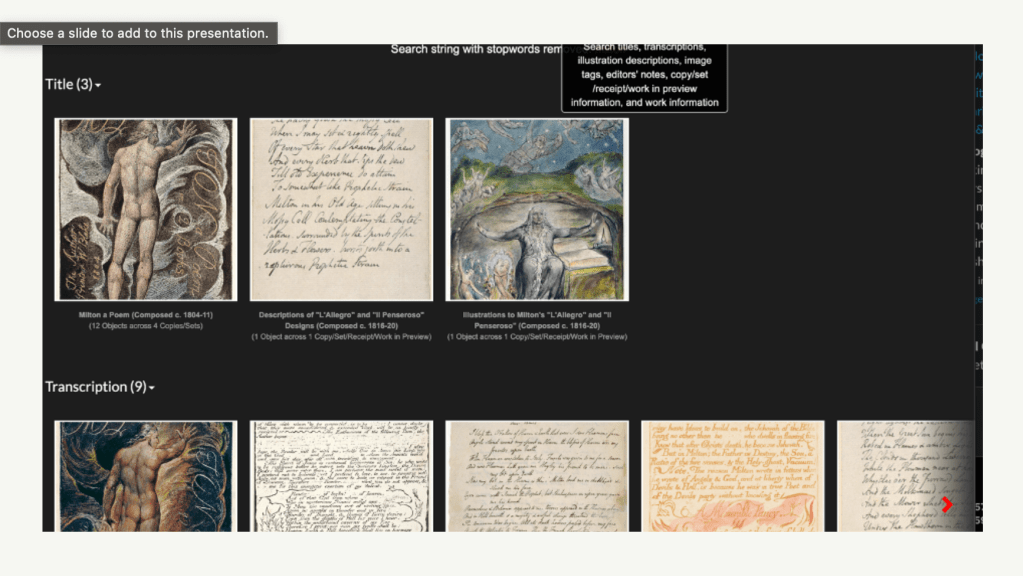
[Slide 10] To give but one example, metadata markup can look like literary interpretation to human users, but it also participates in time-critical effects beyond human intention or interpretation. Since digital memory is not just storage, it must be actively constructed by the processing of the search engine when a user looks for a particular theme or idea within Blake’s work. The Archive maintains its own search engine on its site, which as of 2023 is indexed by Solr. Solr is an open-source program that is used on several commercial and public sites, like the Internet Archive, Instagram, and DuckDuckGo. This program selects a set of searchable words that show up not only in their own search engine but also on sites such as Google. However, the search engine on the Archive is more specialized due to the metadata categories ascribed by Solr. According to the Archive’s Technical Summary, their Solr instance “has three types of documents: a blake_work, a blake_copy, and a blake_object document. This structure allows searching within a work within a copy within an object. […] A user may select a resulting object from a particular copy of a single work, and may filter a search by date, type, or medium.” By indexing in this way, human-generated metadata replicates affordances of print-based textual scholarship, enabling someone with knowledge of print-affordances to access relevant content. Access, in this sense, acts as an operative temporality. On top of poetic questions in Milton regarding the identity of the character in Blake’s poem and philosophical questions about the relationship between the materialities of various copies and our understanding of Blake’s text—queries inherently invoked by the interpretive complexities regarding metadata prescribed for the poem—temporal and historical questions also arise when a user types in “Milton” and is presented with a series of images displayed by the Archive.
In the search shown on the screenshot, there are three results in “Title” and nine results in “Transcription.” Scrolling down includes the following categories with the number of results in parentheses: Illustration Description (5), Image Tag (3), Editor’s Note (5), Copy/Set/Receipt/Work-In-Preview Information (3), and Work Information (10). Already in the display of these texts, we are given an operative assemblage unavailable with any other search. And yet, beyond the desire of the user to find a particular object, such assemblages are not considered narratively meaningful. The search function on the Archive reinscribes the gap between cultural history (in the sense that the user enters “Milton” to find Blake’s illustrations to John Milton’s work or Blake’s poem Milton) and time-critical operations (in which the display of these objects constructs operative shortcuts between texts otherwise dispersed in historical time). It also reveals the recursive and processual nature of the software platforms shaping the digital archiving of Blake’s work.
Further, while metadata categories on the Archive replicate print affordances, Ernst points out that many scholars confuse media affordances for interpretive choices and ignore how much these affordances already inscribe our posthuman subjectivity as a construction of media. He says that human-generated metadata is “logocentric,” since otherwise arbitrary tags are associated with one another through human intervention but are then made to seem historical and meaningful. In the process, “the technical machine becomes perfectly humanized on the figurative, phenomenal level.” Yet, this perfect realization only demonstrates the posthuman condition. In a non-anthropocentric view, he continues, “if a machine can perfectly emulate human memory dynamics, the human memory system might be a technological mechanism itself.” The Archive’s use of Solr relies upon human-generated metadata that replicates print standards, but these standards don’t just ensure the production of an archive with a certain level of quality. The print-inspired categories of the Archive’s metadata also reproduce a version of what Kittler calls a discourse network or inscription system in which the human subject is constructed out of the reproduction of technical standards; or, in his words, a “network of technologies and institutions […] allow a given culture to select, store, and process relevant data.” It’s unclear if Blake or Milton are more relevant to our current discourse network than they were in 1804. But Blake, Milton, and 1804—at least in Ernst’s posthuman formulation of digital memory—exist primarily for the recursive storage and processing of data.
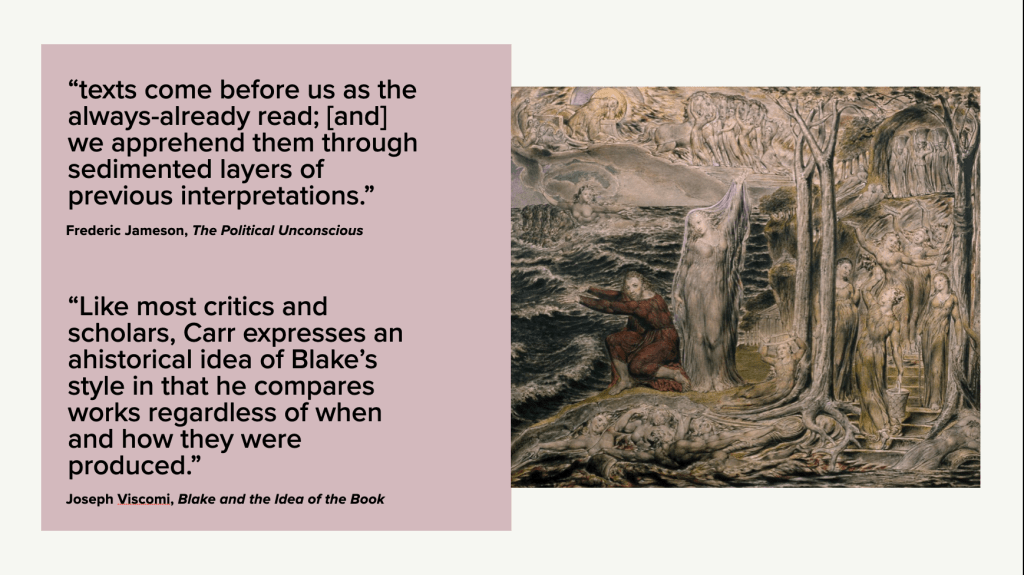
[Slide 11] These time-critical techniques of digital archives also resurrect debates surrounding the reading of Blake’s work and do so in ways that may not have been intended by their authors. In Blake and the Idea of the Book, Viscomi famously critiques Stephen Leo Carr’s argument that print differences in the copies of Blake’s poems signal a radical challenge to the print industry of his day. “Like most critics and scholars,” Viscomi explains, “Carr expresses an ahistorical idea of Blake’s style in that he compares works regardless of when and how they were produced” (165). The Solr indexing system used by the Archive does not erase Viscomi’s crucial historical point or the nature of the challenge Blake intended, but it does throw into question how we understand the cultural techniques that are constructing history. Frederic Jameson shows that “texts come before us as the always-already read; [and] we apprehend them through sedimented layers of previous interpretations.” Additionally, texts are processed through various techniques and technologies with their own affordances—material and temporal. These create effects that complicate a normative historicist reading, including time-critical shortcuts and recursive loops. Looking at the search results on the Archive reveals not a historicized archival display but a mode of reading appropriate to the time-critical techniques of the digital archive itself. While Essick, Viscomi, and Eaves have always admitted the medial properties of the Archive, Rachel Lee states that their goal “is to represent and clarify Blake’s original manuscript with minimal editorial presence.” Even so, the fact that these image-focused search result displays remain on the Archive, along with the capability to view all copies of a particular illuminated book alongside one another, reveals that the debate between Viscomi and Carr is not one of historicity versus ahistoricity. Rather, we see a struggle between two technical standards: one that holds tightly to a single editorial endpoint for Blake scholarship as the meaning of history and another that traces the potential forms that Blake can take as a multiverse of modal possibilities.

 Roger Whitson