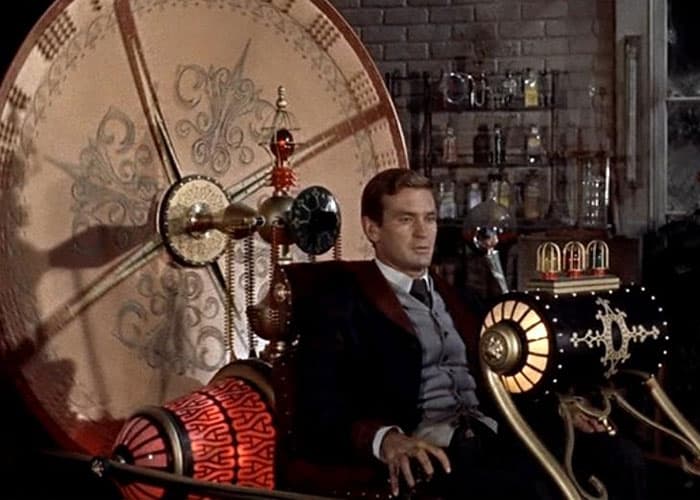
In his history of the time-travel genre as a “narratological laboratory,” David Wittenberg curiously argues that H.G. Wells’s The Time Machine articulates time by referencing the cinema: “the mere press of a lever accomplishes the task of advancing, reversing, or modulating temporal movement, as it would, for instance, in a kinetoscope, a protocinematic device with which Wells was very familiar” (86). The parallel between media and time machine is invoked in the field of media archaeology; in particular, Wolfgang Ernst description of time as “a complex layering of presence and past(s), rich forms of temporal articulation [that] can be identified in a chrono-tonal sense,” as a useful alternative to question of whether time is subjective or objective. This presentation will show how Wells’s book develops a machinic form of time travel as a literary device to delineate and juxtapose three different scales of temporality developed in the nineteenth century: the rapid temporality of the film projector, the prescise of the industrial clock, and the longue durée of natural selection. While Wittenberg sees the time-travel genre as hinging on the development of the time paradox, I suggest that the development of time-critical processes in the nineteenth century reveals Wells’s developing sense of temporal mediation as a fundamental topic for science fiction.
For Ernst time-criticality is the delineation and processing of time by media operations. One of his best examples is mechanical escapement in pendulum clocks. While the sundial measures time by the shadow cast from the sun, forming an indexical relation between time and the sun, mechanical escapement processes time as a series of standardized units operating through a mechanical oscillation that does not have an indexical reference other than its own measurement. I suggest that Wells’s book develops time travel as a mechanism to throw into relief the difference between the cultural artifact as enveloped in a history and the operative mechanism processing time. While this dramatization is particularly present in the artifacts the traveler uses to prove that he traveled to the future, a not-so-subtle reference to the surplus value extracted from colonial holdings, it can also be seen in the mechanism itself as engaging in the act of disciplining organisms from vastly different moments in history through a radical form of time synchronization. For me, Wittenberg’s focus on narratology should be supplemented with an account of how media construct various experimental possibilities for narrative. The machinic modulations of time in Wells’s novel provides a powerful example of the entangled relationship between time, media, and narrative. While the extraction, synchronization, and modulation of time alongside their relationship to capitalist extraction will form the central focus of the presentation; it will also show how Wells’s novel anticipates more recent time travel books that are also interested in time-critical mediation, such as William Gibson’s The Peripheral.
 Roger Whitson